인공지능 상용화 3년, 한국의 AI 생태계 대전환: AI 기본법 시행과 사회적 과제에 대한 심층 분석 보고서
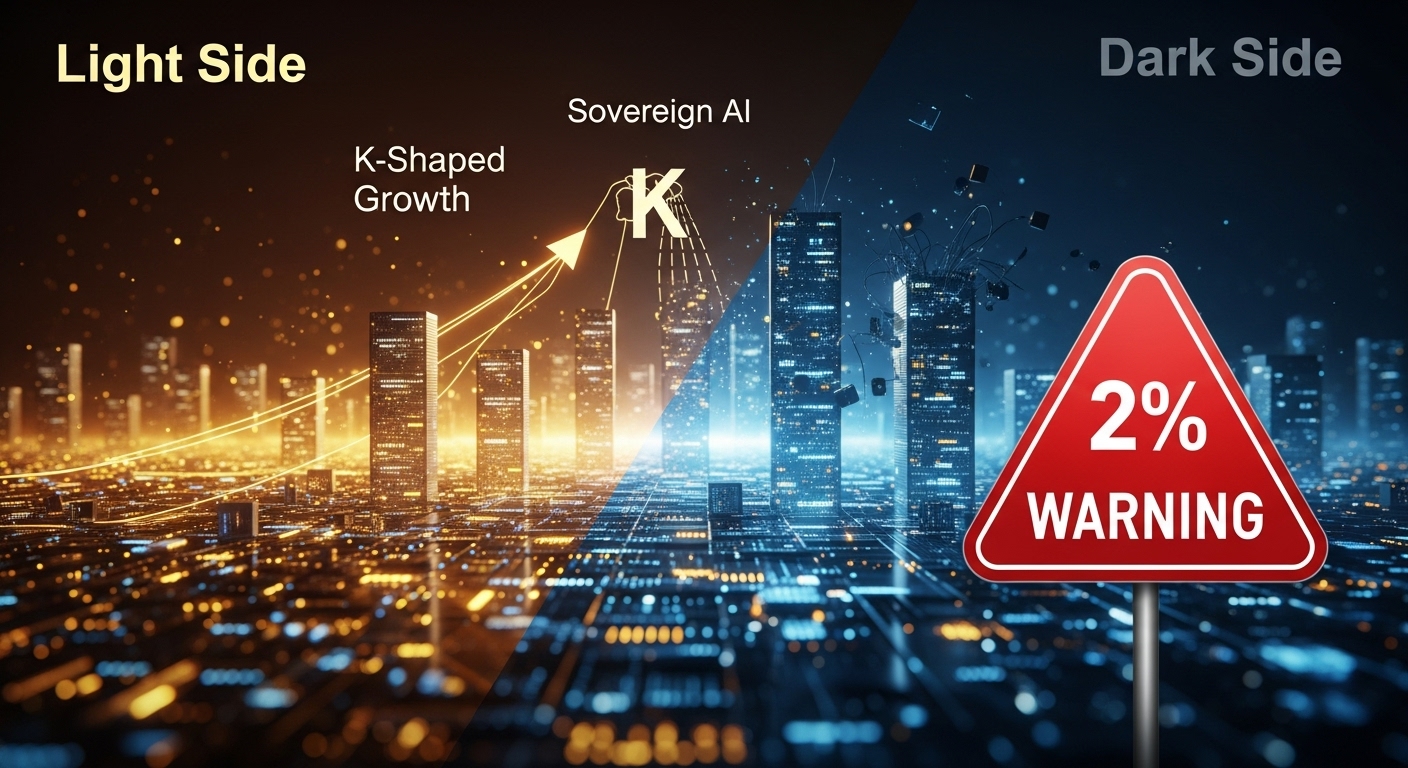
2026년 AI 기본법 시행 이후 3년, 한국의 인공지능 생태계는 거대한 실험을 통과한 셈입니다. 소위 ‘주권 AI(Sovereign AI)’를 외치는 대기업들은 자체 모델과 막대한 인프라로 상층부를 차지하는 반면, 실제로 법·윤리·데이터 거버넌스를 갖춘 스타트업은 2%에 불과합니다.
https://www.youtube.com/watch?v=JJtR5LPUpzs
기술은 상용화되었지만, 의미는 아직 정리되지 않았습니다.
그 사이 한국의 AI 생태계는 ‘주권 AI’라는 이름의 독점화, 준비된 2%와 방치된 98%라는 K자 구조로 조용히 갈라지고 있습니다. Brandon AI 윤리 솔루션 센터는 이 리포트를 통해, 한국 AI 상용화 3년의 명과 암을 ‘기술’이 아니라 ‘윤리와 책임’의 언어로 다시 정리해보고자 합니다.
1. 서론: ‘신기함’을 넘어 ‘기반’으로, AI 상용화 3년의 궤적
2023년, 생성형 인공지능(Generative AI)의 등장은 전 세계 산업과 사회에 충격파를 던졌습니다. 그로부터 3년이 지난 2026년 현재, 한국 사회는 AI 기술을 단순히 신기한 도구로 바라보던 단계를 지나, 국가 경쟁력을 좌우하는 핵심 인프라이자 일상의 필수재로 받아들이는 전환기에 서 있습니다. 2026년 1월 22일, 세계 최초로 시행된 ‘인공지능 발전과 신뢰 기반 조성 등에 관한 기본법(이하 AI 기본법)’은 이러한 시대적 흐름을 반영한 제도적 결실이자, 한국 AI 생태계가 규율과 진흥이라는 양날의 검 위에서 새로운 균형을 모색하기 시작했음을 알리는 신호탄입니다.
지난 3년은 한국 AI 생태계에 있어 질적, 양적 팽창이 폭발적으로 일어난 시기였습니다. 기업들은 AI 전환(AX, AI Transformation)을 생존 전략으로 채택했고, 공공 행정은 지능형 자동화를 통해 효율성을 극대화했습니다. 그러나 빛이 밝으면 그림자도 짙어지는 법입니다. 급격한 기술 도입 속도에 비해 기업들의 윤리적 대비책은 턱없이 부족했으며, 사회적 합의 없이 추진된 교육 현장의 AI 도입은 격렬한 저항에 부딪혔습니다. 특히 ‘비용’ 절감과 ‘효율’이라는 자본의 논리가 ‘안전’과 ‘윤리’라는 사회적 가치를 압도하면서 발생하는 부작용들이 곳곳에서 감지되고 있습니다.
본 보고서는 지난 3년간 한국 AI 생태계에서 발생한 다층적인 변화를 법·제도, 기업 현실, 윤리적 인식, 시민 사회의 영향이라는 네 가지 축을 중심으로 심층 분석합니다. 특히 AI 기본법 시행을 기점으로 드러난 기업들의 준비 부족 현상과 AI 윤리를 비용으로 치부하는 경직된 태도에 대해 비판적으로 고찰하며, 유럽연합(EU)의 AI 법(EU AI Act)과의 비교를 통해 한국형 규제 모델이 나아가야 할 방향을 제시하고자 합니다. 이는 단순한 현황 정리를 넘어, 지속 가능한 AI 생태계를 구축하기 위한 성찰적 제언을 담고 있습니다.
2. 법·제도적 지형의 변화: AI 기본법 시행의 의의와 구조적 한계
2.1. 세계 최초의 포괄적 AI 기본법 시행과 그 배경
2026년 1월 22일 시행된 AI 기본법은 한국이 글로벌 AI 규제 거버넌스에서 주도권을 잡겠다는 의지를 표명한 결과물입니다. 이 법안은 ‘진흥’과 ‘규제’라는 상충될 수 있는 두 가치를 하나의 법안에 담으려 했다는 점에서 독특한 입법 사례로 평가받습니다. 정부는 AI 산업의 불확실성을 해소하고 기업들이 예측 가능한 환경에서 혁신을 추구할 수 있도록 돕는 동시에, AI가 초래할 수 있는 위험으로부터 국민을 보호하기 위한 최소한의 안전장치를 마련한다는 취지를 내세웠습니다.1
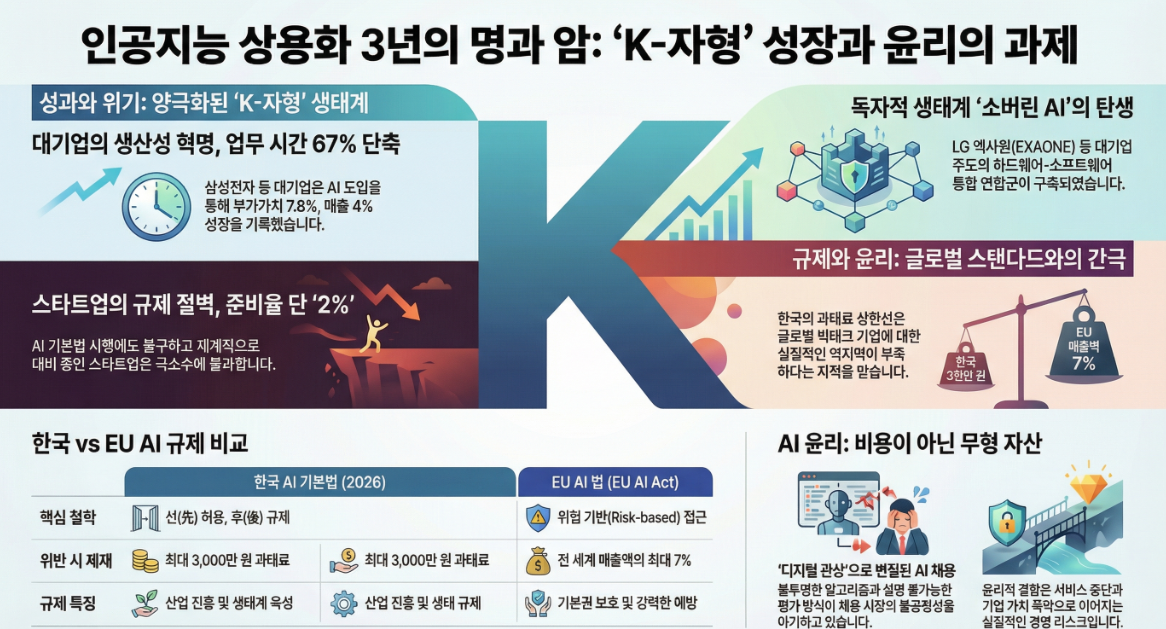
이 법안의 핵심은 AI를 위험도에 따라 분류하고 차등 규제하는 것입니다. 특히 국민의 생명, 신체, 기본권에 중대한 영향을 미칠 수 있는 영역을 ‘고위험(High-Risk) AI’ 또는 ‘고영향 AI’로 지정하여 관리 감독을 강화했습니다. 여기에는 의료, 금융, 교통, 채용, 범죄 수사 등 11개 핵심 분야가 포함됩니다.2 또한, 딥페이크 기술의 오남용을 막기 위해 AI가 생성한 결과물에는 반드시 식별 가능한 표식을 남기도록 하는 ‘투명성 의무’를 명문화했습니다. 이를 위반할 경우 부과되는 과태료는 최대 3,000만 원으로 설정되었습니다.3
2.2. 입법의 구조적 한계: ‘규제’인가 ‘면죄부’인가?
법안 시행에도 불구하고, 학계와 시민사회, 그리고 산업계 일부에서는 이 법안이 실효성을 담보할 수 있는지에 대해 강한 의문을 제기하고 있습니다. 비판의 요지는 크게 세 가지로 요약됩니다.
첫째, 제재의 실효성 부족입니다. AI 기본법 위반 시 부과되는 최대 3,000만 원의 과태료는 수조 원대의 매출을 올리는 빅테크 기업들에게는 사실상 무시해도 좋은 ‘비용’에 불과합니다. 이는 매출액의 일정 비율(최대 7%)을 벌금으로 부과하여 기업의 존폐를 위협할 정도로 강력한 제재를 가하는 EU의 접근 방식과 극명하게 대비됩니다.4 전문가들은 낮은 과태료가 기업들에게 “법을 지키는 비용보다 법을 어기고 과태료를 내는 것이 더 이익”이라는 잘못된 시그널을 줄 수 있다고 경고합니다. 이는 법의 억지력(deterrence)을 상실하게 만드는 치명적인 약점입니다.
둘째, 역차별과 집행 가능성의 문제입니다. 법안은 해외 빅테크 기업들이 국내 대리인을 지정하도록 의무화했지만, 이 대리인이 실질적인 법적 책임이나 의사결정 권한이 없는 단순 연락책(liaison)에 그칠 경우 규제의 사각지대가 발생합니다. 과거 쿠팡 해킹 사태나 글로벌 플랫폼 기업들의 조세 회피 논란에서 보듯, 본사에 대한 직접적인 강제력이 없는 상황에서 국내 대리인 지정은 형식적인 절차에 머무를 공산이 큽니다. 이는 결국 국내법을 준수하기 위해 막대한 컴플라이언스 비용을 지불하는 토종 기업들에게만 족쇄로 작용하는 ‘기울어진 운동장’을 심화시킬 수 있습니다.5
셋째, 규제 기준의 모호성과 현장의 혼란입니다. ‘고영향 AI’를 판단하는 기준으로 제시된 ‘누적 연산량’이나 ‘투명성 확보’를 위한 사전 고지 방식 등이 기술적 현실을 반영하지 못하고 있다는 지적이 나옵니다. 예를 들어, AI가 전체 콘텐츠의 극히 일부분인 배경 수정에만 관여했을 때도 ‘AI 생성물’ 표기를 해야 하는지, 혹은 인간의 창의성이 주도하고 AI가 보조한 경우의 저작권과 표기 의무는 어떻게 되는지에 대한 구체적인 가이드라인이 부재합니다. 이러한 불확실성은 기업들에게 규제 리스크로 작용하며, 특히 법률 대응 능력이 부족한 스타트업들에게는 혁신의 장벽이 되고 있습니다.1
3. 기업 생태계의 현실: 양극화된 준비와 ‘K-자형’ 성장
지난 3년간 한국 기업 생태계는 AI 도입을 통해 생산성을 비약적으로 향상시켰습니다. 그러나 그 내막을 들여다보면 대기업과 중소·스타트업 간의 격차가 극심하게 벌어지는 ‘K-자형’ 양극화 현상이 뚜렷합니다.
3.1. 대기업: ‘소버린 AI’ 구축과 초격차 전략
자본력과 데이터, 인프라를 모두 갖춘 대기업들은 외부 의존도를 줄이고 독자적인 AI 생태계를 구축하는 ‘소버린 AI(Sovereign AI)’ 전략에 집중했습니다. 이는 단순히 기술을 도입하는 차원을 넘어, AI를 기업의 핵심 DNA로 이식하는 과정이었습니다.
·LG 그룹의 초거대 AI ‘엑사원(EXAONE)’ 생태계: LG AI연구원이 주도하는 ‘엑사원’은 한국형 소버린 AI의 성공적인 모델로 꼽힙니다. LG는 단순히 모델 개발에 그치지 않고, 퓨리오사AI(NPU 하드웨어), 슈퍼브AI(데이터 라벨링 및 관리), LG CNS(SI 및 서비스) 등 10개 기업이 참여하는 거대한 연합군을 형성했습니다.
이러한 컨소시엄 전략은 하드웨어부터 소프트웨어, 서비스에 이르는 ‘풀 스택(Full-stack)’ 경쟁력을 확보하게 했습니다. 엑사원은 정부 주관의 평가에서 벤치마크, 전문가, 사용자 평가 전 부문 최고점을 획득하며 기술적 완성도를 입증했고,
이를 바탕으로 의료, 바이오, 화학 등 전문적인 도메인 지식이 필요한 분야로 확장하고 있습니다.6
·삼성전자의 업무 혁신: 삼성전자는 자체 개발한 생성형 AI ‘가우스’ 등을 사내 업무에 전면 도입하여 일하는 방식의 혁명을 일으켰습니다. 보고서 작성, 코드 리뷰, 번역 등 단순 반복 업무에 AI를 투입함으로써 업무 수행 시간을 최대 67%까지 단축시키는 성과를 거두었습니다. 이는 임직원들이 고부가가치 창출에 집중할 수 있는 환경을 조성했으며, AI 도입 기업이 미도입 기업 대비 부가가치 7.8%, 매출 4% 증가라는 실질적인 경제적 성과를 누리고 있음을 증명하는 사례입니다.10
3.2. 스타트업: 규제의 파고 앞에서의 표류
반면, 혁신의 최전선에 있어야 할 AI 스타트업들은 AI 기본법 시행이라는 거대한 파고 앞에서 방향을 잃고 표류하고 있습니다.
·충격적인 준비 실태: 스타트업얼라이언스의 설문조사 결과는 충격적입니다. AI 스타트업 중 기본법 시행에 체계적으로 대비하고 있는 기업은 고작 "2%"에 불과했습니다. 절반에 가까운 48.5%는 법의 세부 내용을 전혀 모르고 있었으며, 내용을 인지하고 있는 기업들조차 48%가 준비 미흡을 호소했습니다.1 이는 스타트업들이 기술 개발에는 능하지만, 법적 규제에 대응할 행정적, 재정적 여력이 턱없이 부족함을 시사합니다.
·비용의 딜레마: 스타트업들이 가장 두려워하는 것은 ‘규제 준수 비용(Compliance Cost)’입니다. AI 신뢰성 인증을 받기 위해 필요한 데이터셋 검증, 투명성 보고서 작성, 고위험 AI 사전 등록 절차 등은 소규모 인력으로 운영되는 스타트업에게 막대한 업무 부담을 줍니다. 기술 개발에 투입되어야 할 핵심 엔지니어들이 서류 작업에 매달려야 하는 상황은 기업의 경쟁력을 갉아먹는 요인이 됩니다. 또한, 자신이 개발한 서비스가 규제 대상인지 아닌지를 판단하는 것조차 모호한 상황에서, 불확실성을 회피하기 위해 서비스 출시를 연기하거나 사업 방향을 수정하는 사례도 속출하고 있습니다.2
4. 비판적 분석: AI 윤리를 ‘비용’으로 취급하는 자본의 민낯
지난 3년간 한국 사회에서 AI 기술은 빛의 속도로 발전했지만, 이를 통제하고 감시해야 할 윤리 의식은 제자리걸음을 면치 못했습니다. 특히 기업 현장에서는 AI 윤리를 투자가 아닌 ‘비용’으로, 안전성 검증을 ‘규제’로 인식하는 경향이 팽배해 있습니다. 이러한 인식의 지체(Lag) 현상은 다양한 사회적 문제를 야기하고 있습니다.
4.1. 채용 시장의 불공정성: ‘블랙박스’ 면접관의 횡포
AI 면접은 효율성이라는 미명 하에 공공기관과 대기업을 중심으로 빠르게 확산되었습니다. 그러나 그 이면에는 ‘설명 불가능성’과 ‘검증되지 않은 알고리즘’이라는 심각한 문제가 도사리고 있습니다.
·과학인가, 관상인가?: 많은 기업들이 지원자의 표정, 목소리 톤, 사용하는 단어의 빈도 등을 AI로 분석하여 역량을 평가한다고 주장합니다. 그러나 전문가들은 이러한 방식이 과학적 근거가 부족한 ‘디지털 관상’에 불과할 수 있다고 비판합니다. 인간의 복잡한 내면과 직무 역량을 단 몇 분의 영상 분석으로 판단하는 것은 기술적 한계가 명확함에도 불구하고, 기업들은 채용 비용 절감을 위해 이를 강행하고 있습니다.13
·알고리즘의 불투명성: 과거 아마존이 AI 채용 시스템에서 여성 관련 단어(예: ‘여대’, ‘여성 동아리’)가 포함된 이력서를 무조건 감점 처리했던 사례는 알고리즘 편향성의 위험을 극명하게 보여주었습니다. 한국에서도 지원자들은 자신이 왜 탈락했는지, AI가 어떤 기준으로 점수를 매겼는지 전혀 알 수 없습니다. 기업들은 알고리즘을 ‘영업비밀’이라며 공개를 거부하고 있어, 청년 구직자들은 보이지 않는 심판관 앞에서 영문도 모른 채 좌절하고 있습니다.14
·AI 대 AI의 대결: 최근에는 구직자들이 ‘인터뷰 코더(Interview Coder)’와 같은 AI 도구를 활용해 실시간으로 면접 질문의 답을 생성해내며 AI 면접관을 속이는 사례까지 등장했습니다. 이는 채용 과정이 인간의 역량을 평가하는 장이 아니라, 누가 더 정교한 AI 도구를 사용하는지를 겨루는 기술 전쟁터로 변질되었음을 보여줍니다. AI가 문제를 내고 AI가 답을 푸는 이 기이한 상황은 AI 윤리가 무너진 채용 시장의 단면을 보여줍니다.16
4.2. 금융권의 설명 요구권 침해와 데이터 결정론
은행권에 도입된 AI 대출 심사 시스템 역시 윤리적 논란의 중심에 있습니다.
·설명할 수 없는 거절: 신용점수가 높고 소득이 안정적인 직장인이 대출을 거절당하는 사례가 발생하고 있습니다. 이유는 황당하게도 ‘새벽 시간에 대출 앱에 접속했다’거나 ‘배달 앱 사용 빈도가 높다’, ‘스마트폰 배터리가 자주 방전된다’와 같은 비금융 데이터 때문일 수 있습니다. AI는 이러한 패턴을 ‘재정적 불안정’이나 ‘충동적 성향’으로 해석할 수 있지만, 은행 측은 고객에게 구체적인 거절 사유를 설명하지 못합니다. 단지 “AI의 종합적 판단”이라는 말로 책임을 회피할 뿐입니다. 이는 금융소비자보호법상의 ‘설명 요구권’을 무력화하는 것이며, 인간의 삶을 이해할 수 없는 데이터 파편으로 재단하는 데이터 결정론의 폐해입니다.17
4.3. ‘윤리 워싱(Ethics Washing)’과 안전 불감증
많은 기업들이 홈페이지와 지속가능경영 보고서에 화려한 ‘AI 윤리 헌장’을 게시하고 있습니다. 그러나 이것이 실제 서비스 개발 프로세스에 녹아들지 않고 마케팅 수단으로만 활용되는 ‘윤리 워싱’ 현상이 심각합니다. 김명주 서울여대 교수는 “안전 확보 없이는 AI 개발비만 낭비하는 꼴”이라고 경고하며, 과거 ‘이루다’ 사태와 같이 윤리적 결함이 서비스 중단과 기업 가치 폭락으로 이어질 수 있음을 지적했습니다.18 그럼에도 불구하고 현장에서는 당장의 출시 일정을 맞추기 위해 ‘레드 팀(Red Teaming, 취약점 점검 팀)’ 운영을 축소하거나 윤리 검증을 요식행위로 넘기는 경우가 비일비재합니다.
5. 시민의 일상과 가족, 그리고 교육: 편의와 공포의 공존
AI 기술은 시민들의 삶을 편리하게 만들었지만, 동시에 가족의 안전을 위협하고 교육 현장에 갈등을 유발하는 새로운 스트레스 요인이 되었습니다.
5.1. 딥페이크 성범죄: 일상을 파고든 공포
AI 기술의 가장 어두운 그림자는 딥페이크 성범죄의 확산입니다. 과거에는 연예인이 주요 표적이었으나, 이제는 일반인, 대학생, 심지어 미성년자인 중고등학생까지 범죄의 대상이 되고 있습니다. 피해자들은 가해자가 누구인지도 모르는 상태에서 자신의 얼굴이 합성된 음란물이 텔레그램 등 음지에서 유포될지 모른다는 극심한 심리적 고통을 겪습니다. AI 기본법이 워터마크 표시를 의무화했지만, 범죄 목적의 가해자들이 이를 준수할 리 만무하다는 점에서 법적 실효성에 대한 회의론이 지배적입니다. 이는 기술이 인간의 존엄성을 훼손하는 가장 악질적인 사례로 기록되고 있습니다.19
5.2. AI 디지털 교과서: 데이터 주권과 교육의 본질에 대한 충돌
정부가 2025년부터 본격 도입을 추진 중인 ‘AI 디지털 교과서’는 교육 현장을 찬반의 소용돌이로 몰아넣었습니다.
·학부모의 불안: 학부모들은 자녀의 학습 데이터, 성향, 행동 패턴 등 민감한 정보가 사기업인 에듀테크 업체들의 서버에 저장되고 활용되는 것에 대해 깊은 불신을 가지고 있습니다. 개인정보 유출 사고가 빈번한 한국 사회에서, 내 아이의 모든 정보가 기업의 AI 학습용 데이터로 쓰일 수 있다는 우려는 단순한 기우가 아닙니다.20
·교사들의 반발: 교사들은 AI 기기 과의존으로 인한 문해력 저하, 검증되지 않은 교육 효과, 기기 관리 업무 폭증 등을 이유로 도입 유보를 강력히 주장하고 있습니다. 국회 청원에 5만 명 이상이 동의하며 법안 개정 요구가 빗발치는 것은, 현장의 목소리를 무시한 하향식(Top-down) 정책 추진이 어떤 갈등을 초래하는지를 보여줍니다.21
5.3. 행정의 진화: 서울시의 RPA 혁명
반면, 공공 행정 분야에서의 AI 도입은 긍정적인 변화를 이끌어내고 있습니다. 서울시는 AI와 로봇 프로세스 자동화(RPA)를 결합하여 단순 반복 업무를 획기적으로 줄였습니다. 예를 들어, 연말정산이나 보험료 정산, 민원 게시글 분류 등의 업무를 자동화함으로써 월 2,000시간 이상의 업무 시간을 절감했습니다. 이는 공무원들이 단순 행정 처리에서 벗어나 시민의 복잡한 민원을 해결하고 창의적인 정책을 기획하는 데 집중할 수 있게 하여, 결과적으로 대시민 서비스의 질을 높이는 선순환 구조를 만들었습니다.25
6. 글로벌 비교 분석: 한국 AI 기본법 vs. EU AI 법 (EU AI Act)
한국과 유럽연합(EU)은 AI 규제에 있어 상반된 철학을 가지고 접근하고 있습니다. 이 차이는 향후 한국 기업들의 글로벌 진출 전략에 중대한 변수가 될 것입니다.
| 구분 | 한국 AI 기본법 (2026 시행) | EU AI 법 (EU AI Act) |
| 규제 철학 | ‘선(先) 허용, 후(後) 규제’ 산업 진흥과 생태계 육성에 방점. 후발 주자로서의 기술 추격 의지 반영. |
‘위험 기반(Risk-based) 접근’ 기본권 보호와 안전 최우선. 예방적 차원의 강력한 규제. |
| 위반 시 제재 | 최대 3,000만 원 과태료 (매출액과 연동되지 않는 고정 금액) |
전 세계 연간 매출액의 최대 7% 또는 3,500만 유로 중 높은 금액. (징벌적 수준) |
| 고위험 AI 정의 | 11개 분야(의료, 채용 등) 지정 및 사전 고지 의무 중심. | 4단계 위험 등급(금지, 고위험, 제한적 위험, 최소 위험) 분류. 금지 등급(사회적 점수제 등)은 원천 차단. |
| 특징 | 국내 기업 보호 및 진흥책 포함. 규제 샌드박스 등 유예 및 지원 중심. |
‘브뤼셀 효과(Brussels Effect)’를 노린 역외 적용. 전 세계 기업에 동일한 기준 강제. |
| 기업 영향 | 규제 비용 부담은 낮으나, 글로벌 스탠다드 미달 시 수출 경쟁력 약화 우려. 역차별 논란 존재. |
막대한 컴플라이언스 비용 발생. 위반 시 기업 존폐 위기. |
6.1. 비교 시사점: 이중 규제의 덫과 전략적 선택
한국의 AI 기본법은 명확히 "진흥"에 무게를 두고 있습니다. 이는 미국과 중국이라는 AI G2 사이에서 독자적인 기술 생태계를 확보해야 한다는 국가적 절박함이 반영된 결과입니다.4 그러나 최대 3,000만 원이라는 솜방망이 처벌은 글로벌 스탠다드, 특히 EU의 기준과 비교했을 때 규제 공백으로 비칠 수 있습니다.3
문제는 한국 기업들이 내수 시장에만 머물지 않는다는 점입니다. 삼성전자, LG전자, 네이버 등 한국의 주요 기업들이 EU 시장에 AI가 탑재된 가전이나 서비스를 수출하기 위해서는, 국내법보다 훨씬 가혹한 EU AI 법을 준수해야 합니다. 즉, 한국 기업들은 국내에서는 상대적으로 느슨한 규제에 적응해 있다가, 해외 진출 시 갑작스럽게 높은 규제 장벽에 부딪히는 **‘이중 규제 대응’**의 부담을 안게 됩니다.29 따라서 국내법을 준수하는 것만으로는 글로벌 경쟁력을 담보할 수 없으며, 기업들은 선제적으로 EU 수준의 높은 윤리적 가이드라인을 내재화해야 하는 과제를 안고 있습니다.
7. 결론 및 제언: 지속 가능한 AI 강국을 향한 로드맵
지난 3년간 한국은 AI 기술의 도입기에서 확산기로 넘어오는 숨 가쁜 여정을 거쳤습니다. 2026년 AI 기본법의 시행은 무법지대였던 AI 영역에 최소한의 질서를 부여하려는 첫걸음이라는 점에서 의미가 큽니다. 그러나 본 보고서의 분석 결과, 현재의 생태계는 대기업 위주의 불균형 성장, 스타트업의 규제 대응 능력 부재, 그리고 윤리를 비용으로 치부하는 기업들의 안일한 인식 등 구조적인 취약점을 안고 있음이 드러났습니다.
진정한 AI 강국으로 도약하기 위해, 그리고 기술이 인간을 소외시키지 않고 공존하기 위해 다음과 같은 제언을 도출합니다.
1.AI 윤리의 ‘자산화(Assetization)’ 인식 전환: 경영진은 AI 윤리와 안전성 확보가 불필요한 비용이 아니라, 리스크를 헷징(Hedging)하고 브랜드 가치를 높이는 핵심 무형 자산임을 깨달아야 합니다. 소비자는 더 이상 윤리적으로 결함이 있는 AI를 신뢰하지 않습니다. ‘설명 가능한 AI(XAI)’ 기술에 대한 투자를 늘리고, 알고리즘의 투명성을 자발적으로 강화하는 것이 장기적인 생존 전략입니다.
2.스타트업 맞춤형 ‘규제 사다리’ 제공: 2%에 불과한 준비율은 곧 다가올 스타트업 줄도산의 예고편일 수 있습니다. 정부는 획일적인 규제 적용 대신, 기업 규모와 리스크 수준에 따른 단계적 규제 적용(규제 사다리)을 도입해야 합니다. 또한, 법률 전문가가 없는 스타트업을 위해 ‘AI 컴플라이언스 원스톱 지원센터’를 설립하여 실질적인 법률·기술 컨설팅을 제공해야 합니다.
3.법제도의 실효성 강화와 역차별 해소: 3,000만 원의 과태료 상한은 상향 조정될 필요가 있습니다. 특히 해외 빅테크 기업에 대해서는 매출액 기반의 과징금 제도를 도입하는 방안을 검토하여, 국내 기업과의 역차별을 해소하고 법의 집행력을 확보해야 합니다.
4.사회적 합의 기구의 상설화: AI 디지털 교과서나 채용 면접과 같이 사회적 파급력이 큰 사안에 대해서는 정부의 일방적인 추진을 지양해야 합니다. 교사, 학부모, 학생, 구직자, 전문가가 참여하는 상설 협의체를 구성하여 기술 도입의 속도를 조절하고, 부작용에 대한 안전장치를 먼저 마련한 후 도입하는 ‘선(先) 합의, 후(後) 도입’ 원칙을 확립해야 합니다.
AI는 더 이상 미래의 기술이 아닙니다. 그것은 이미 우리의 밥상머리에, 교실에, 그리고 면접장에 들어와 있습니다. 기술의 발전 속도에 맞춰 우리의 제도와 윤리 의식, 그리고 사회적 합의의 수준을 끌어올리는 것만이 지난 3년의 혼란을 넘어 성숙한 AI 사회로 나아가는 길일 것입니다.
“AI 상용화 3년, 숫자와 제도는 어느 정도 자리를 잡아가고 있습니다. 하지만 여전히 질문은 남습니다.
우리는 기술을 키웠을까요, 아니면 불평등을 키웠을까요?”
www.youtube.com/@BrandonAIEthics
Brandon AI Ethics. All about AI Ethics
Brandon AI윤리 Solution Center(BAESC)Brandon AI 윤리솔루션센터 기술은 빠르게 진화하지만, 우리는 그 속도를 따라가기보다 의미를 지켜갑니다. Brandon Ethics는 인공지능 시대의 윤리, 책임, 그리고 신뢰를
www.youtube.com
3 Years of AI Commercialization, The Great Transformation of Korea’s AI Ecosystem: An In-depth Analysis on the Enforcement of the AI Basic Act and Social Challenges
1. Introduction: Beyond Novelty to Infrastructure, The Trajectory of 3 Years of AI Commercialization
In 2023, the emergence of Generative AI sent shockwaves through industries and societies worldwide. Three years later, in 2026, Korean society stands at a transition point where AI technology is no longer viewed merely as a fascinating tool but accepted as a core infrastructure determining national competitiveness and a daily necessity. On January 22, 2026, the world's first enforcement of the "Framework Act on Promotion of Artificial Intelligence and Creation of Trust Foundation" (hereinafter referred to as the AI Basic Act) represents an institutional fruition reflecting this zeitgeist and signals that Korea’s AI ecosystem has begun seeking a new balance on the double-edged sword of regulation and promotion.
The past three years have been a period of explosive qualitative and quantitative expansion in Korea's AI ecosystem. Companies adopted AI Transformation (AX) as a survival strategy, and public administration maximized efficiency through intelligent automation. However, where the light is bright, the shadows are deep. Compared to the rapid speed of technology adoption, companies' ethical preparedness was woefully inadequate, and the introduction of AI in education without social consensus faced fierce resistance. In particular, side effects are being detected everywhere as the capitalist logic of "cost" reduction and "efficiency" overwhelms social values such as "safety" and "ethics."
This report deeply analyzes the multi-layered changes that have occurred in Korea's AI ecosystem over the past three years, focusing on four axes: laws and institutions, corporate reality, ethical perception, and the impact on civil society. Specifically, it critically examines the lack of corporate preparation revealed by the enforcement of the AI Basic Act and the rigid attitude of dismissing AI ethics as a cost. Through a comparison with the European Union's AI Act, this report suggests the direction in which the Korean regulatory model should proceed. This goes beyond a simple status summary to include reflective suggestions for building a sustainable AI ecosystem.
2. Changes in the Legal and Institutional Landscape: Significance and Structural Limitations of the AI Basic Act
2.1. Enforcement of the World's First Comprehensive AI Basic Act and Its Background
The AI Basic Act, enforced on January 22, 2026, is the result of Korea's expression of its will to take the lead in global AI regulatory governance. This legislation is evaluated as a unique legislative case in that it attempted to contain the conflicting values of "promotion" and "regulation" in a single bill. The government claimed the purpose was to resolve uncertainties in the AI industry, help companies pursue innovation in a predictable environment, and simultaneously establish minimum safety measures to protect citizens from potential risks posed by AI.1
The core of this bill is to classify and differentially regulate AI according to risk levels. In particular, areas that can have a significant impact on citizens' lives, physical safety, and fundamental rights were designated as "High-Risk AI" or "High-Impact AI," subject to strengthened supervision. This includes 11 key sectors such as medical care, finance, transportation, recruitment, and criminal investigation.2 Additionally, to prevent the misuse of deepfake technology, the "transparency obligation" was codified to mandate identifiable marks on AI-generated outputs. The fine for violating this was set at a maximum of 30 million KRW.3
2.2. Structural Limitations of Legislation: 'Regulation' or 'Indulgence'?
Despite the enforcement of the bill, academia, civil society, and parts of the industry strongly question whether this bill can guarantee effectiveness. The criticism can be summarized in three main points.
First is the lack of effectiveness in sanctions. The maximum fine of 30 million KRW for violating the AI Basic Act is virtually a negligible "cost" for big tech companies generating trillions of won in revenue. This contrasts sharply with the EU's approach, which imposes fines as a percentage of revenue (up to 7%), threatening the very existence of the company to enforce strong sanctions.4 Experts warn that low fines can give companies the wrong signal that "it is more profitable to break the law and pay the fine than to pay the cost of compliance." This is a fatal weakness that causes the law to lose its deterrence.
Second is the issue of reverse discrimination and enforceability. Although the bill mandates foreign big tech companies to designate domestic agents, regulatory blind spots arise if these agents remain mere liaisons without substantial legal responsibility or decision-making authority. As seen in the past Coupang hacking incident or global platform companies' tax avoidance controversies, the designation of domestic agents is likely to remain a formal procedure without direct enforcement power against headquarters. This could deepen the "tilted playing field" that acts as shackles only for domestic companies paying enormous compliance costs to adhere to domestic laws.5
Third is the ambiguity of regulatory standards and confusion in the field. It is pointed out that criteria such as "cumulative computation amount" presented for judging "High-Impact AI" or prior notice methods for "securing transparency" do not reflect technological reality. For example, there are no concrete guidelines on whether "AI-generated product" labeling is required when AI is involved only in background modification, which is a tiny fraction of the total content, or how copyright and labeling obligations apply when human creativity leads and AI assists. This uncertainty acts as a regulatory risk for companies and becomes a barrier to innovation, especially for startups lacking legal response capabilities.1
3. Reality of the Corporate Ecosystem: Polarized Preparation and 'K-Shaped' Growth
Over the past three years, the Korean corporate ecosystem has dramatically improved productivity through AI adoption. However, looking inside, a "K-shaped" polarization phenomenon where the gap between large conglomerates and SMEs/startups widens extremely is evident.
3.1. Conglomerates: 'Sovereign AI' Construction and Super-Gap Strategy
Conglomerates equipped with capital, data, and infrastructure focused on the "Sovereign AI" strategy to reduce external dependence and build independent AI ecosystems. This was a process of transplanting AI as the core DNA of the company, beyond simply adopting technology.
·LG Group's Hyperscale AI 'EXAONE' Ecosystem: 'EXAONE', led by LG AI Research, is cited as a successful model of Korean Sovereign AI. LG did not stop at model development but formed a massive alliance involving 10 companies, including FuriosaAI (NPU hardware), SuperbAI (data labeling and management), and LG CNS (SI and services). This consortium strategy secured "Full-stack" competitiveness ranging from hardware to software and services. EXAONE proved its technological perfection by achieving top scores in all categories of government-led evaluations—benchmark, expert, and user evaluations—and based on this, it is expanding into fields requiring specialized domain knowledge such as medical, bio, and chemistry.6
·Samsung Electronics' Work Innovation: Samsung Electronics fully introduced its self-developed generative AI 'Gauss' into internal operations, revolutionizing the way work is done. By deploying AI for simple repetitive tasks such as report writing, code review, and translation, they achieved results shortening task performance time by up to 67%. This created an environment where employees could focus on high-value-added creation and is a case proving that AI-adopting companies enjoy substantial economic achievements, such as a 7.8% increase in value-added and a 4% increase in revenue compared to non-adopting companies.10
3.2. Startups: Drifting in Front of the Waves of Regulation
On the other hand, AI startups, which should be at the forefront of innovation, are losing direction and drifting in front of the huge wave of the AI Basic Act enforcement.
·Shocking Preparation Status: The survey results from Startup Alliance are shocking. Only 2% of AI startups were systematically preparing for the Basic Act. Nearly half, 48.5%, did not know the details of the law at all, and even among companies aware of the content, 48% complained of insufficient preparation.1 This implies that while startups are capable in technology development, they lack the administrative and financial capacity to respond to legal regulations.
·Dilemma of Cost: What startups fear most is "Compliance Cost." Verifying datasets, writing transparency reports, and prior registration procedures for high-risk AI required to receive AI reliability certification impose a massive workload burden on startups operated by small workforces. A situation where core engineers who should be invested in technology development are tied up in paperwork becomes a factor eroding corporate competitiveness. Furthermore, in a situation where it is ambiguous whether the service they developed is subject to regulation, cases of postponing service launches or modifying business directions to avoid uncertainty are appearing one after another.2
4. Critical Analysis: The Bare Face of Capital Treating AI Ethics as a 'Cost'
While AI technology in Korean society has developed at the speed of light over the past three years, the ethical consciousness to control and monitor it has been stagnant. Particularly in corporate fields, there is a prevailing tendency to perceive AI ethics as a "cost" rather than an investment, and safety verification as "regulation." This "Lag" phenomenon in perception is causing various social problems.
4.1. Unfairness in the Hiring Market: Tyranny of the 'Black Box' Interviewer
AI interviews spread rapidly, centered on public institutions and conglomerates, under the pretext of efficiency. However, serious problems of "unexplainability" and "unverified algorithms" lurk behind them.
·Science or Physiognomy?: Many companies claim to evaluate competence by analyzing applicants' facial expressions, voice tones, and word frequency with AI. However, experts criticize this method as potentially nothing more than "digital physiognomy" lacking scientific basis. Despite the clear technological limitations of judging human complex inner workings and job competencies with just a few minutes of video analysis, companies are enforcing this to reduce hiring costs.13
·Opacity of Algorithms: The past case where Amazon unconditionally penalized resumes containing female-related words (e.g., "women's university," "women's club") in its AI hiring system clearly showed the danger of algorithmic bias. Even in Korea, applicants cannot know why they were rejected or by what criteria the AI scored them. Companies refuse to disclose algorithms claiming they are "trade secrets," leaving young job seekers frustrated without knowing the reason before an invisible judge.14
·AI vs. AI Battle: Recently, cases have emerged where job seekers use AI tools like "Interview Coder" to generate answers to interview questions in real-time, deceiving AI interviewers. This shows that the recruitment process has degenerated into a technological battlefield competing on who uses more sophisticated AI tools, rather than a place to evaluate human competence. This bizarre situation where AI asks questions and AI solves answers reveals a cross-section of a hiring market where AI ethics have collapsed.16
4.2. Infringement of Right to Explanation in Finance and Data Determinism
The AI loan screening systems introduced in the banking sector are also at the center of ethical controversy.
·Unexplainable Rejection: Cases occur where office workers with high credit scores and stable incomes are denied loans. The reasons can be absurdly based on non-financial data, such as "accessed the loan app at dawn," "high frequency of delivery app usage," or "smartphone battery is frequently discharged." AI may interpret these patterns as "financial instability" or "impulsive tendencies," but the bank cannot explain the specific reason for rejection to the customer. They merely evade responsibility with the phrase "AI's comprehensive judgment." This neutralizes the "right to explanation" under the Financial Consumer Protection Act and is a harmful consequence of data determinism that judges human life with incomprehensible data fragments.17
4.3. 'Ethics Washing' and Safety Insensitivity
Many companies post flashy "AI Ethics Charters" on their websites and sustainability reports. However, the phenomenon of "Ethics Washing," where this is used only as a marketing tool without being integrated into the actual service development process, is serious. Professor Kim Myung-joo of Seoul Women's University warned that "without securing safety, it is merely wasting AI development costs," pointing out that ethical defects can lead to service suspension and a plunge in corporate value, as seen in the past "Lee Luda" incident.18 Nevertheless, in the field, it is common to reduce the operation of "Red Teams" (vulnerability inspection teams) or pass ethical verification as a mere formality to meet immediate launch schedules.
5. Citizens' Daily Lives, Families, and Education: Coexistence of Convenience and Fear
AI technology has made citizens' lives convenient, but at the same time, it has become a new stressor threatening family safety and causing conflict in educational settings.
5.1. Deepfake Sexual Crimes: Fear Penetrating Daily Life
The darkest shadow of AI technology is the spread of deepfake sexual crimes. In the past, celebrities were the main targets, but now ordinary people, college students, and even minors such as middle and high school students are becoming targets of crimes. Victims suffer extreme psychological pain, fearing that pornographic materials synthesized with their faces might be circulated in shadowy places like Telegram without knowing who the perpetrator is. Although the AI Basic Act mandated watermark labeling, skepticism about legal effectiveness is dominant given that perpetrators with criminal intent are unlikely to comply. This is recorded as the most vicious case of technology damaging human dignity.19
5.2. AI Digital Textbooks: Clash Over Data Sovereignty and the Essence of Education
The "AI Digital Textbook," which the government is pushing for full-scale introduction from 2025, has driven the educational field into a vortex of pros and cons.
·Parents' Anxiety: Parents have deep distrust regarding sensitive information such as their children's learning data, tendencies, and behavioral patterns being stored and used on the servers of private EdTech companies. in Korean society, where personal information leakage accidents are frequent, the concern that my child's entire information could be used as AI training data for companies is not a groundless fear.20
·Teachers' Resistance: Teachers are strongly arguing for the postponement of the introduction, citing reasons such as decline in literacy due to over-dependence on AI devices, unverified educational effects, and an explosion in device management tasks. The fact that demands for bill revision are pouring in, with over 50,000 people agreeing to the National Assembly petition, shows what kind of conflict top-down policy promotion ignoring voices from the field causes.21
5.3. Evolution of Administration: Seoul City's RPA Revolution
On the other hand, AI adoption in the public administration sector is leading to positive changes. The Seoul Metropolitan Government combined AI and Robotic Process Automation (RPA) to drastically reduce simple repetitive tasks. For example, by automating tasks such as year-end tax settlement, insurance premium settlement, and civil complaint post classification, they saved over 2,000 hours of work time monthly. This created a virtuous cycle that increased the quality of services for citizens by allowing public officials to escape simple administrative processing and focus on resolving complex civil complaints and planning creative policies.25
6. Global Comparative Analysis: Korea AI Basic Act vs. EU AI Act
Korea and the European Union (EU) approach AI regulation with opposing philosophies. This difference will be a critical variable in the future global expansion strategies of Korean companies.
| Category | Korea AI Basic Act (Enforced 2026) | EU AI Act |
| Regulatory Philosophy | 'Allow First, Regulate Later' Focus on industry promotion and ecosystem nurturing. Reflects will to catch up technologically as a latecomer. |
'Risk-based Approach' Prioritizes fundamental rights and safety. Strong regulation at a preventive level. |
| Sanctions for Violation | Max. 30 Million KRW Fine (Fixed amount not linked to revenue) |
Max. 7% of Global Annual Turnover or 35 million EUR, whichever is higher. (Punitive level) |
| Definition of High-Risk AI | Designated 11 sectors (Medical, Hiring, etc.) centered on prior notice obligation. | 4-level risk classification (Unacceptable, High, Limited, Minimal). Unacceptable level (Social Scoring, etc.) is banned. |
| Features | Includes measures for domestic corporate protection and promotion. Focus on grace periods and support like Regulatory Sandbox. |
Extraterritorial application aiming for 'Brussels Effect'. Enforces same standards on companies worldwide. |
| Corporate Impact | Low regulatory cost burden, but concerns over weakened export competitiveness if failing global standards. Reverse discrimination controversy exists. |
Massive compliance costs generated. Crisis for corporate survival upon violation. |
6.1. Comparative Implications: The Trap of Double Regulation and Strategic Choice
Korea's AI Basic Act clearly places weight on "Promotion." This reflects the national desperation to secure an independent technological ecosystem between the AI G2 of the US and China.4 However, the slap-on-the-wrist punishment of maximum 30 million KRW can be seen as a regulatory void when compared to global standards, especially EU criteria.3
The problem is that Korean companies do not stay only in the domestic market. For Korea's major companies like Samsung Electronics, LG Electronics, and Naver to export AI-equipped appliances or services to the EU market, they must comply with the EU AI Act, which is far harsher than domestic laws. In other words, Korean companies bear the burden of "Double Regulation Response," where they adapt to relatively loose regulations domestically but suddenly face high regulatory barriers when entering overseas markets.29 Therefore, complying with domestic laws alone cannot guarantee global competitiveness, and companies face the task of preemptively internalizing EU-level high ethical guidelines.
7. Conclusion and Suggestions: Roadmap Towards a Sustainable AI Powerhouse
Over the past three years, Korea has gone through a breathless journey moving from the introduction phase to the diffusion phase of AI technology. The enforcement of the AI Basic Act in 2026 is significant in that it is the first step to give minimum order to the previously lawless AI domain. However, the analysis of this report reveals that the current ecosystem bears structural vulnerabilities such as unbalanced growth centered on conglomerates, lack of regulatory response capability among startups, and the complacent perception of companies dismissing ethics as a cost.
To leap forward as a true AI powerhouse, and for technology to coexist without alienating humans, the following suggestions are derived.
1.Paradigm Shift to 'Assetization' of AI Ethics: Executives must realize that ensuring AI ethics and safety is not an unnecessary cost but a core intangible asset that hedges risk and enhances brand value. Consumers no longer trust AI that is ethically defective. Increasing investment in "Explainable AI (XAI)" technology and voluntarily strengthening algorithmic transparency is a long-term survival strategy.
2.Providing 'Regulatory Ladder' Tailored for Startups: A readiness rate of only 2% may be a preview of a coming wave of startup bankruptcies. Instead of uniform regulation application, the government should introduce phased regulation application (Regulatory Ladder) according to company size and risk level. Also, it should establish an "AI Compliance One-Stop Support Center" for startups without legal experts to provide practical legal and technical consulting.
3.Strengthening Legal Effectiveness and Resolving Reverse Discrimination: The upper limit of the 30 million KRW fine needs to be adjusted upward. In particular, for foreign big tech companies, introducing a revenue-based penalty system should be considered to resolve reverse discrimination against domestic companies and secure law enforcement power.
4.Institutionalizing Social Consensus Bodies: For issues with significant social impact, such as AI digital textbooks or recruitment interviews, unilateral promotion by the government should be avoided. A permanent consultative body involving teachers, parents, students, job seekers, and experts should be formed to regulate the speed of technology adoption and establish the principle of "Consensus First, Introduction Later," preparing safety measures for side effects first.
AI is no longer a technology of the future. It has already entered our dining tables, classrooms, and interview rooms. Raising the level of our institutions, ethical consciousness, and social consensus to match the speed of technological development is the only way to move beyond the confusion of the past three years toward a mature AI society.
참고 자료
1.세계 최초로 'AI 기본법' 오늘 시행…"우리도 고위험AI? 규정 모호해" - 머니S, 세계 최초로 'AI 기본법' 오늘 시행…"우리도 고위험AI? 규정 모호해" - 머니S
2.세계 최초, AI 기본법 시행 임박…산업계 “기준 모호·준비 시간 부족” 지적 - MS TODAY, 세계 최초, AI 기본법 시행 임박…산업계 “기준 모호·준비 시간 부족” 지적 - MS TODAY
3.[비즈톡톡] 'AI 생성물' 표기 안하면 과태료 3000만원… AI 기본법, 진흥인가 족쇄인가,[비즈톡톡] ‘AI 생성물’ 표기 안하면 과태료 3000만원… AI 기본법, 진흥인가 족쇄인가
4.Korea's Won? South Korea's AI Basic Act: Asia's first comprehensive AI legislation, Korea’s Won? South Korea’s AI Basic Act: Asia’s first comprehensive AI legislation
5.한국, 오늘부터 세계 최초로 AI 규제 시작, 한국, 오늘부터 세계 최초로 AI 규제 시작
6.구광모의 AI 청사진 'K-엑사원', 국가 AI 프로젝트 선두구광모의 AI 청사진 'K-엑사원', 국가 AI 프로젝트 선두 - 소비자가 만드는 신문
7.LG AI연구원, ‘K-엑사원’ 세계 최고 AI 모델 만들겠다,LG AI연구원, ‘K-엑사원’ 세계 최고 AI 모델 만들겠다
8.구광모 ‘선택과 집중’ 통했다…LG ‘K-엑사원’으로 국가 AI 생태계 확장, 구광모 ‘선택과 집중’ 통했다…LG ‘K-엑사원’으로 국가 AI 생태계 확장 - 비즈트리뷴
9.독자 기술 집약한 'K-엑사원' 공개 - 보도자료 | 미디어 | LG, 독자 기술 집약한 ‘K-엑사원’ 공개
10.2025 기업 AI 활용 사례 : 국내 주요 기업들의 AI 도입 성과와 전략, 2025 기업 AI 활용 사례 : 국내 주요 기업들의 AI 도입 성과와 전략
11.삼성SDS가 만든 '생성형 AI' 솔루션…업무 수행시간 '단축' - 연합인포맥스,삼성SDS가 만든 '생성형 AI' 솔루션…업무 수행시간 '단축'
12.“AI에이전트로 업무시간 67% 단축”…삼성SDS '공무원의 하루' 눈길 - Daum, “AI에이전트로 업무시간 67% 단축”…삼성SDS ‘공무원의 하루’ 눈길
13.표정 개선했지만 AI 면접관은 점수 더 주지 않았다 - 조선일보,표정 개선했지만 AI 면접관은 점수 더 주지 않았다
14.“이력서에 '여성' 들어가면 감점”…아마존 AI 채용, 도입 취소 - 조선일보,“이력서에 ‘여성’ 들어가면 감점”…아마존 AI 채용, 도입 취소
15."공공기관 AI면접, 믿을 수 있나"…시민단체, 정보공개 소송, "공공기관 AI면접, 믿을 수 있나"…시민단체, 정보공개 소송
16.사람 대신 아마존 면접 뚫은 AI! - 월간 리크루트,사람 대신 아마존 면접 뚫은 AI! - 월간 리크루트
17.AI가 당신을 평가한다…신용점수 700점인데 대출 거절된 이유, AI가 당신을 평가한다…신용점수 700점인데 대출 거절된 이유 - 테크42
18.[Interview] 김명주 인공지능안전연구소 초대 소장 “안전 확보 없이는 AI 개발비만 낭비…기업 돕는 '셰르파' 될 것” - 이코노미조선, [Interview] 김명주 인공지능안전연구소 초대 소장 “안전 확보 없이는 AI 개발비만 낭비…기업 돕는 ‘셰르파’ 될 것”
19.“가해자 알 수 없으니 더 두려워”…딥페이크 피해자의 호소 / KBS 2025.04.18. - YouTube, “가해자 알 수 없으니 더 두려워”…딥페이크 피해자의 호소 / KBS 2025.04.18.
20.[디정위][공동 성명] 학생 정보인권 침해하는 AI 디지털교과서 사업 즉각 중단하라, [디정위][공동 성명] 학생 정보인권 침해하는 AI 디지털교과서 사업 즉각 중단하라
21.학부모 85% 'AI디지털교과서' 도입 반대 - 한국스마트에듀테크협동조합, 학부모 85% ‘AI디지털교과서’ 도입 반대
22.1만명 교사 개인정보 유출한 교육부, 개인정보보호 대책 없으면 AI 디지털교과서 개발 유예해야, 1만명 교사 개인정보 유출한 교육부, 개인정보보호 대책 없으면 AI 디지털교과서 개발 유예해야
23.'AI 교과서' 도입 거부 청원도…"사고·이해력 저하" 우려 목소리 / JTBC 뉴스룸 - YouTube, 'AI 교과서' 도입 거부 청원도…"사고·이해력 저하" 우려 목소리 / JTBC 뉴스룸
24. [기사] 에듀테크는 분주한데…AI교과서 도입은 주춤 - K2Web Wizard -, [기사] 에듀테크는 분주한데…AI교과서 도입은 주춤
25.공공기관이 AI 도입·활용 선도조직으로 나선다, 공공기관이 AI 도입·활용 선도조직으로 나선다
26. AI와 RPA 결합 `지능형 행정`…서울시, 매달 2000시간 자동 처리, AI와 RPA 결합 `지능형 행정`…서울시, 매달 2000시간 자동 처리
27.서울시, AI+RPA로 '지능형 행정자동화' 속도… 매달 2000시간 업무 로봇이 처리 - 현대경제,서울시, AI+RPA로 ‘지능형 행정자동화’ 속도… 매달 2000시간 업무 로봇이 처리
28.[서울특별시] 전국 최초 AI·RPA 결합 '지능형 행정', 매달 2000시간 이상 반복업무 자동화 성과...공무원 역량 '기획 · 분석 중심'으로 이동 - 한국지방정부신문, [서울특별시] 전국 최초 AI·RPA 결합 ‘지능형 행정’, 매달 2,000시간 이상 반복업무 자동화 성과...공무원 역량 '기획 · 분석 중심'으로 이동
29.International: A comparative analysis of high-risk AI laws | Opinion - OneTrust DataGuidance,International: A comparative analysis of high-risk AI laws | Opinion | DataGuidance
30.Article 99: Penalties | EU Artificial Intelligence Act, Article 99: Penalties | EU Artificial Intelligence Act
#KoreaAIAct #ArtificialIntelligence #AIEthics #CorporateResponsibility #DigitalTransformation #AIRegulation #EUAIACt #Deepfake #AlgorithmicBias #SovereignAI #AI기본법 #인공지능윤리 #디지털교과서 #딥페이크 #알고리즘편향 #소버린AI #스타트업규제 #AI채용면접
'닥터 브랜든 모드 진료실 > AI윤리 심층 진단' 카테고리의 다른 글
| 인공지능 전환 시대의 신사회 안전망: AI 보험의 필연성과 글로벌 리스크 관리 체계에 관한 연구 (0) | 2026.02.20 |
|---|---|
| "AI 시대의 로빈슨 크루소: '선과 악의 장부'로 되찾는 나의 데이터 주권" (0) | 2026.02.04 |
| 2026년 한국 인공지능 기본법의 심층 분석 및 EU AI Act와의 비교법적 고찰: 규제 공백의 역설과 글로벌 표준의 압력 (0) | 2026.01.16 |
| [심층연구] 슈타지의 ‘영혼 파괴’에서 AI의 ‘행동 조작’까지: 디지털 판옵티콘의 도래 (0) | 2026.01.01 |
| 2025년 동지(冬至)와 애동지의 민속학적 고찰: 역사적 유래, 국제적 비교 및 현대적 계승 방안에 대한 심층 보고서 (0) | 2025.12.22 |


