2025년 동지(冬至)와 애동지의 민속학적 고찰: 역사적 유래, 국제적 비교 및 현대적 계승 방안에 대한 심층 보고서
서론: 동지(冬至), 어둠의 극점과 빛의 태동에 관한 인문학적 탐구

2025년 12월 22일에 도래하는 동지(冬至)는 24절기 중 스물두 번째 절기로, 천문학적으로는 태양의 황경이 270도에 위치하는 시점입니다. 북반구에서는 태양이 가장 남쪽(남회귀선)에 위치하여 일 년 중 밤이 가장 길고 낮이 가장 짧은 날이 됩니다. 그러나 동지는 단순한 천문 현상을 넘어 인류사적으로 ‘죽음과 재생’, ‘어둠과 빛’의 경계를 상징하는 중대한 변곡점으로 인식되어 왔습니다. 고대 농경 사회에서 태양은 생명의 근원이었기에, 태양의 힘이 가장 약해지는 동지는 두려움의 대상인 동시에, 이날을 기점으로 다시 낮이 길어지기 시작한다는 점에서 ‘태양의 부활’을 알리는 희망의 절기이기도 했습니다.1
본 보고서는 동지의 심층적인 의미를 분석합니다. 특히 사용자의 요청에 따라 올해 동지가 ‘애동지’로 분류되는 역법적 배경과 윤달의 상관관계를 과학적이고 민속학적인 관점에서 규명합니다. 또한, 한국의 동지 풍습과 유사성을 보이는 중국, 베트남, 이란(페르시아), 서구권의 사례를 비교 문화론적으로 고찰하여 인류가 공유해 온 ‘겨울의 정점’에 대한 문화적 대응 방식을 탐구합니다. 나아가 현대 사회에서 동지가 갖는 사회적 가치를 재조명하고, 단순한 미신적 풍습을 넘어선 현대적 계승 방안을 제시하고자 합니다.
1. 동지(冬至)의 천문학적 원리와 역법 체계
1.1 24절기와 태양의 운행
동지는 태양의 움직임을 기준으로 한 태양력(solar calendar)의 요소입니다. 지구의 자전축이 23.5도 기울어진 상태로 공전하기 때문에 계절의 변화가 발생하며, 동지 시점에 태양은 남위 23.5도인 동지선(남회귀선) 위에 머물게 됩니다. 이로 인해 북반구는 태양 고도가 가장 낮아져 입사하는 태양 에너지가 최소화되고, 이는 물리적인 겨울의 정점을 의미합니다.3 옛사람들은 이를 음(陰)의 기운이 극에 달한 날로 보았으나, 동시에 이 순간이 지나면 양(陽)의 기운이 싹튼다고 하여 ‘일양시생(一陽始生)’의 철학적 의미를 부여했습니다.2
1.2 윤달과 2025년 애동지의 상관관계 분석
2025년 동지가 ‘애동지’로 분류되는 이유는 태양력과 태음력의 주기를 맞추기 위한 ‘윤달(Leap Month)’의 배치와 밀접한 관련이 있습니다.
1.태음태양력의 원리: 음력 1년(약 354일)은 양력 1년(약 365일)보다 약 11일이 짧습니다. 이 오차를 보정하기 위해 약 2~3년마다 한 번씩 윤달을 끼워 넣습니다.4
2.윤달의 영향: 2025년에는 음력 6월 다음에 ‘윤 6월’이 배치됩니다. 윤달이 삽입되면 그 뒤에 오는 음력 날짜들은 양력 날짜에 비해 뒤로 밀리게 됩니다. 즉, 평년이라면 음력 11월이 양력 12월 중순경 시작되겠지만, 윤달이 낀 해에는 음력 11월의 시작이 늦어집니다.
3.애동지의 결정: 동지는 양력 12월 21~23일경으로 고정되어 있습니다. 윤달로 인해 음력 날짜가 뒤로 밀린 해에는, 양력 12월 22일이 되었음에도 불구하고 음력으로는 아직 11월 초순(1일~10일)에 머물게 됩니다.
4.2025년의 구체적 날짜: 2025년 12월 22일(양력)은 음력으로 11월 2일에 해당합니다. 이는 음력 11월 초순에 해당하므로 명백한 ‘애동지’가 됩니다.3
따라서 “윤달이 끼어서 애동지”라는 말은, 윤달이 든 해는 음력 날짜가 늦게 가기 때문에 양력으로 고정된 동지가 음력 동짓달의 초반부에 걸릴 확률이 매우 높다는 역법적 인과관계를 설명하는 민간의 지혜입니다.
2. 한국 동지의 역사와 유형별 풍습
2.1 ‘작은 설’ 아세(亞歲)와 국가적 의례
한국 역사에서 동지는 설날에 버금가는, 혹은 그 이상의 위상을 지닌 명절이었습니다. 『동국세시기(東國歲時記)』에 따르면 동지는 ‘아세(亞歲)’, 즉 ‘작은 설’로 불렸습니다. 이는 주나라(周)에서 동지를 새해의 시작으로 삼았던 천설(天雪) 사상의 영향을 받은 것입니다. 때문에 “동지를 지나야 나이를 한 살 더 먹는다”는 속담은 단순한 비유가 아니라 고대 역법을 반영한 사회적 합의였습니다.1
조선시대 관상감(觀象監)에서는 동짓날 새해 달력을 만들어 임금에게 진상했고, 임금은 ‘동문지보(同文之寶)’라는 어새를 찍어 백관에게 하사했습니다. 이를 ‘하선동력(夏扇冬曆)’이라 하여 여름에는 부채를, 겨울에는 달력을 선물하는 풍습이 있었는데, 이는 농경사회에서 절기를 아는 것이 곧 생존과 직결되었음을 시사합니다.2 고려시대에는 동지를 전후하여 팔관회(八關會)가 열렸으며, 이는 부처님과 천지신명에게 국가의 안녕을 비는 거국적인 불교 행사였습니다.6
2.2 동지의 유형과 식문화의 금기(Taboo)
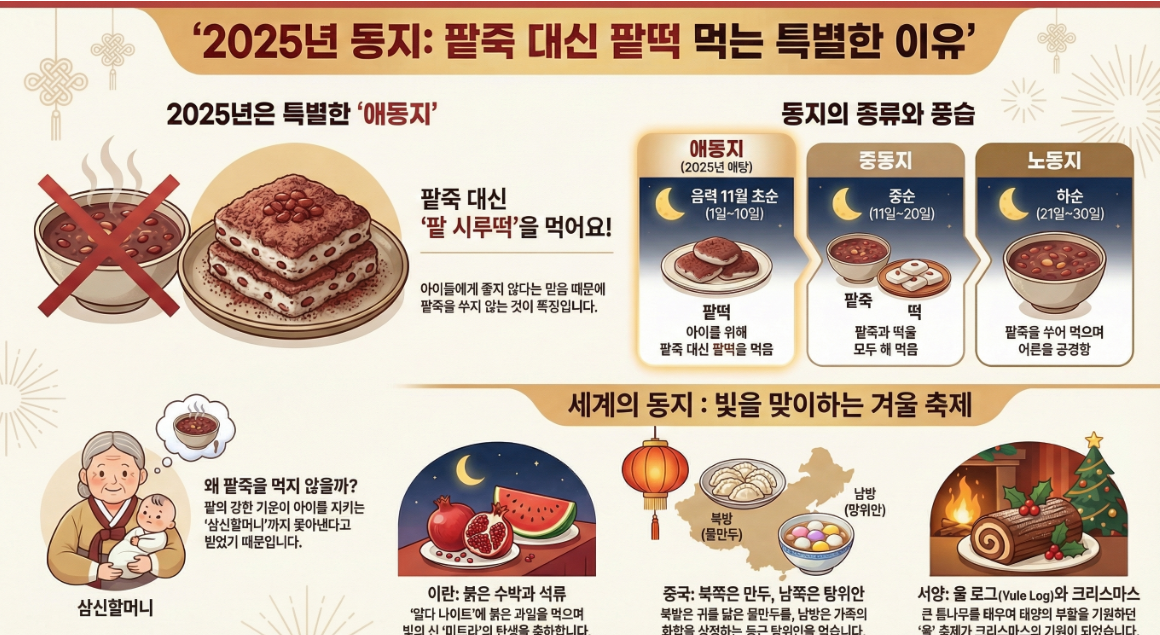
한국의 동지는 음력 11월의 어느 시기에 드느냐에 따라 세 가지로 구분되며, 이에 따른 식문화의 차이가 명확합니다.1
| 구분 | 시기 (음력 11월) | 명칭 | 특징 및 풍습 | 2025년 해당 여부 |
| 애동지 (아동지) | 초순 (1일 ~ 10일) | 아기 동지 | 아이에게 좋지 않다 하여 팥죽을 금하고 팥떡(시루떡)을 먹음 | 해당 (음력 11월 2일) |
| 중동지 | 중순 (11일 ~ 20일) | 중년 동지 | 팥죽과 떡을 모두 해 먹음 | 해당 없음 |
| 노동지 | 하순 (21일 ~ 30일) | 노인 동지 | 팥죽을 쑤어 먹으며 경로효친의 의미를 다짐 | 해당 없음 |
왜 애동지에는 팥죽을 먹지 않는가?
2025년 애동지에 팥죽을 피하는 풍습에는 두 가지 주요한 민속학적 해석이 존재합니다.
1.삼신할머니 설: 집안의 아이들을 점지하고 보호하는 가택신인 ‘삼신할머니’는 아이들을 돌보기 위해 강림해야 합니다. 그러나 팥의 붉은색이 가진 강력한 벽사(辟邪, 귀신을 쫓음) 능력이 삼신할머니마저 쫓아낼 수 있다는 우려 때문에, 붉은 국물이 있는 죽 대신 고형식인 떡을 해서 바쳤습니다.3
2.양기의 충돌 설: 아이들은 성장하는 존재로서 양기(陽氣)가 충만합니다. 동지는 일양(一陽)이 시생하는 날로 양기가 태동하는데, 여기에 붉은 팥죽의 양기까지 더해지면 아이들에게 기운이 너무 넘쳐 탈이 날 수 있다는 음양오행적 배려가 담겨 있습니다.
2.3 호랑이 장가가는 날과 날씨 점(占)
민간에서는 동지를 ‘호랑이 장가가는 날’이라고도 부릅니다. 이는 밤이 길고 음기가 강한 동지에 산군(山君)인 호랑이가 교미를 하여 번식을 도모한다는 동물 생태학적 상상력이 결합된 것입니다.5
또한 동지의 날씨로 새해의 농사를 점치기도 했습니다.
·날씨가 춥고 눈이 오면: "동지 때 추워야 풍년이 든다"하여 길조로 여겼습니다. 이는 병해충이 겨울 추위에 박멸되기 때문입니다.7
·날씨가 따뜻하면: 이듬해 질병이 돌고 호랑이가 많아진다고 하여 흉조로 여겼습니다. 2025년 동지의 기온이 평년보다 높다면 질병 예방에 유의해야 한다는 현대적 해석으로 연결될 수 있습니다.7
3. 세계의 동지 유사 풍습 비교 연구
동지는 한국만의 명절이 아니며, 북반구 농경 문화권 전체에서 공유하는 보편적인 절기입니다. 각국은 ‘어둠을 이겨내고 빛을 맞이한다’는 공통된 주제 아래 독창적인 음식과 의례를 발전시켰습니다.
3.1 이란(페르시아): 얄다 나이트 (Yalda Night)
이란과 중앙아시아 지역에서는 동지를 ‘샤브 에 얄다(Shab-e Yalda)’라고 부르며 성대하게 기념합니다.8
·빛의 승리: ‘얄다’는 탄생을 의미하며, 조로아스터교의 전통에서 빛의 신 미트라(Mithra)가 어둠을 물리치고 탄생하는 날로 여겨집니다. 한국의 동지가 ‘작은 설’로서 태양의 부활을 의미하는 것과 정확히 일맥상통합니다.
·붉은색의 공유: 한국이 붉은 팥을 먹는다면, 이란 사람들은 수박과 석류를 먹습니다.9 수박과 석류의 붉은색은 ‘새벽의 여명’과 ‘생명의 불꽃’을 상징하며, 이를 섭취함으로써 병마를 물리치고 건강을 기원합니다. 가족들이 모여 밤새 깨어 있으며 페르시아의 시성 하페즈(Hafez)의 시를 낭송하는 낭만적인 풍습이 있습니다.
3.2 중국: 지역별로 다른 동지(冬至) 음식
중국에서 동지는 춘절(설날) 다음으로 중요한 명절입니다. ‘동지대여년(冬至大如年, 동지는 설만큼 크다)’이라는 말이 있을 정도입니다.10
·남방 (탕위안): 상하이 등 남부 지역에서는 **탕위안(Tangyuan, 湯圓)**을 먹습니다.11 찹쌀가루로 빚은 둥근 경단으로, 한국의 새알심과 유사하나 팥죽에 넣기보다는 맑은 설탕물이나 국물에 띄워 먹거나 쪄먹습니다. 둥근 모양은 가족의 ‘단란함(團圓)’을 상징합니다.
·북방 (교자 만두): 베이징 등 북부 지역에서는 **물만두(Jiaozi)**를 먹습니다. 이는 의성(医聖) 장중경이 추운 동지에 동상 걸린 사람들의 귀를 치료하기 위해 양고기와 약재를 넣어 귀 모양의 만두를 만들어 나누어 준 데서 유래했습니다.12
3.3 베트남: 쩨 트로이와 한식(Han Thuc)의 구분
베트남의 동지 문화는 한국이나 중국과는 다른 양상을 보이며, 흔히 ‘한식’과 혼동되기도 합니다.
·한식(Tet Han Thuc)과의 혼동 주의: 베트남에는 음력 3월 3일에 ‘한식(Tet Han Thuc)’ 명절이 있는데, 이때 **반 트로이(Banh Troi)**라는 찹쌀 경단을 먹습니다.14 이 음식이 중국의 동지 음식인 탕위안이나 한국의 새알심과 매우 흡사하여, 일부 자료에서는 베트남 사람들이 동지에 이를 먹는 것으로 오해하기도 합니다.
·동지(Dong Chi): 베트남은 열대 기후라 겨울의 의미가 약하지만, 화교 커뮤니티나 북부 지역을 중심으로 동지(Dong Chi)를 기념합니다.16 이때는 조상을 기리고 가족의 결속을 다지며, 탕위안과 유사한 달콤한 수프인 ‘쩨(Che)’ 종류를 즐깁니다. 베트남의 동지는 ‘불을 금하는’ 한식의 풍습보다는 조상 숭배와 가족 모임에 초점이 맞춰져 있습니다.14
3.4 서양: 율(Yule) 축제와 성탄절의 기원
서구권의 크리스마스(12월 25일) 또한 고대 동지 축제에 그 뿌리를 두고 있습니다.
·율(Yule): 북유럽 게르만족은 동지를 ‘율’이라 부르며, 태양이 다시 돌아오기를 기원하며 큰 통나무(Yule Log)를 태웠습니다. 이는 불의 기운으로 태양을 돕고자 했던 주술적 행위로, 한국에서 동지 팥죽을 대문에 뿌려 양기를 북돋는 행위와 인류학적으로 유사한 심성을 보여줍니다.2
4. 현대 사회에서 동지의 가치와 계승 방안
2025년의 동지는 과거의 농경 의례가 아닌, 현대 도시 사회의 맥락에서 재해석되어야 합니다.
4.1 '액운'의 현대적 재정의와 나눔 문화 (Social Welfare)
과거의 액운이 귀신이나 호랑이였다면, 현대의 액운은 ‘사회적 고립’, ‘빈곤’, ‘우울’과 같은 사회적 문제입니다.
·계승 방안: 동지 팥죽 나눔 행사를 현대적 ‘복지 축제’로 확장해야 합니다. 조계사 등에서 행해지는 팥죽 나눔 17을 넘어, 지자체와 기업이 연계하여 1인 가구, 독거노인, 소외 계층에게 팥죽(혹은 2025년의 경우 팥떡)을 배달하는 캠페인을 제안합니다. 이는 동지의 ‘벽사’ 기능을 ‘사회적 안전망 강화’라는 현대적 가치로 승화시키는 것입니다.
4.2 K-Culture 콘텐츠로서의 동지: '서울윈터페스타'
서울시가 12월에 개최하는 ‘서울윈터페스타(Seoul Winter Festa)’와 같은 겨울 축제는 동지의 현대적 계승의 좋은 사례입니다.18
·계승 방안: 가장 긴 밤을 ‘빛’으로 채우는 미디어 파사드나 빛 축제는 동지의 ‘일양시생(빛의 부활)’ 의미를 시각 예술로 표현한 것입니다. 이를 더욱 발전시켜, 동지(Winter Solstice)를 한국의 전통적인 ‘연말 파티’ 개념으로 브랜딩 할 수 있습니다. 팥을 활용한 퓨전 디저트(팥 라떼, 앙버터 호두과자 등)를 축제 음식으로 개발하여 젊은 층과 외국인 관광객에게 ‘K-Soul Food’로 어필해야 합니다.19
4.3 2025년 애동지의 가정 내 실천: 육아와 가족
2025년 애동지의 특수성인 ‘아이를 위한 날’을 적극 활용해야 합니다.
·계승 방안: 저출산 시대에 아이들의 건강과 안녕을 기원하는 것은 그 어느 때보다 중요한 가치입니다. 가정에서는 팥시루떡을 아이들과 함께 만들거나 나누어 먹으며, 자녀의 성장을 축하하는 ‘한국형 어린이 축제’의 요소를 도입할 수 있습니다. 이는 할로윈과 같은 외래 축제에 대응하여 우리 고유의 시즌 이벤트를 정착시키는 계기가 될 것입니다.
5. 결론
2025년 12월 22일 동지는 윤달의 영향으로 음력 11월 2일에 드는 애동지입니다. 이날은 전통적인 금기에 따라 팥죽 대신 팥시루떡을 나누며, 집안의 아이들이 건강하게 자라기를 기원하는 따뜻한 배려가 깃든 날입니다. 동지는 단순한 절기를 넘어, 한국을 비롯한 이란, 중국, 베트남 등 전 세계가 ‘어둠 속에서 빛을 기다리는 마음’을 공유하는 인류 보편의 문화유산입니다.
우리는 동지를 박제된 전통으로 남겨두지 말고, 현대 사회의 아픔을 치유하고 이웃을 돌보는 ‘나눔의 날’이자, 가장 긴 밤을 빛과 문화로 즐기는 ‘겨울 축제’로 계승해야 합니다. 붉은 팥에 담긴 벽사의 의미가 현대인들의 마음속 불안을 쫓아내고, 서로의 안녕을 묻는 따뜻한 연대로 이어지기를 희망합니다.
www.youtube.com/@BrandonAIEthics
Brandon AI Ethics. All about AI Ethics
Brandon AI윤리 Solution Center(BAESC)Brandon AI 윤리솔루션센터 기술은 빠르게 진화하지만, 우리는 그 속도를 따라가기보다 의미를 지켜갑니다. Brandon Ethics는 인공지능 시대의 윤리, 책임, 그리고 신뢰를
www.youtube.com
A Comprehensive Report on the Ethnology of 2025 Dongji (Winter Solstice) and Ae-Dongji: Origins, International Comparisons, and Strategies for Modern Succession
Introduction: Humanistic Inquiry into Dongji, the Nadir of Darkness and the Embryo of Light
Dongji (Winter Solstice), arriving on December 22, 2025, is the 22nd of the 24 solar terms. Astronomically, it marks the point when the sun's celestial longitude reaches 270 degrees. In the Northern Hemisphere, the sun is positioned at its southernmost point (the Tropic of Capricorn), resulting in the longest night and the shortest day of the year. However, beyond this astronomical phenomenon, Dongji has been historically perceived as a significant turning point symbolizing the boundary between "death and rebirth" and "darkness and light." In ancient agrarian societies where the sun was the source of life, Dongji—when the sun's power is weakest was a time of fear, yet simultaneously a hopeful season signaling the "resurrection of the sun," as daylight begins to lengthen from this day forward.1
This report provides an in-depth analysis of the significance of Dongji ahead of the year 2025 (Year of the Blue Snake, Eulsa-nyeon). Specifically, addressing the user's request, we will investigate the calendar background that classifies this year's solstice as "Ae-Dongji" (Baby Solstice) and its correlation with the leap month (Yun-dal) from scientific and ethnological perspectives. Furthermore, by engaging in a comparative cultural study of similar customs in China, Vietnam, Iran (Persia), and the West, we explore how humanity has culturally responded to the "peak of winter." Finally, we aim to re-illuminate the social value of Dongji in modern society and propose methods for its succession beyond mere superstitious customs.
1. Astronomical Principles and Calendar System of Dongji
1.1 The 24 Solar Terms and Solar Movement
Dongji is an element of the solar calendar based on the movement of the sun. Because the Earth's rotational axis is tilted at 23.5 degrees while orbiting, seasonal changes occur. At the time of Dongji, the sun stays over the Tropic of Capricorn (23.5 degrees South Latitude). Consequently, the Northern Hemisphere experiences the lowest solar altitude and minimal solar energy input, signifying the physical peak of winter.3 Ancients viewed this as the day when Yin (阴) energy reached its extreme, but also assigned it the philosophical meaning of Ilyang Sisaeng (一陽始生), meaning "One Yang begins to sprout," signifying the rebirth of Yang energy.2
1.2 Analysis of the Correlation Between Leap Month and 2025 Ae-Dongji
The classification of the 2025 Dongji as "Ae-Dongji" is closely related to the placement of the "Leap Month" to synchronize the solar and lunar calendars.
1.Principle of Lunisolar Calendar: A lunar year (approx. 354 days) is about 11 days shorter than a solar year (approx. 365 days). To correct this discrepancy, a leap month is inserted approximately every 2-3 years.4
2.Impact of Leap Month: In 2025, a "Leap June" is inserted after the lunar June. When a leap month is added, the subsequent lunar dates are pushed back relative to the solar calendar. Thus, while the lunar November would typically begin around mid-December in a common year, it starts later in a year with a leap month.
3.Determination of Ae-Dongji: Dongji is fixed around December 21-23 in the solar calendar. In a year where lunar dates are delayed due to a leap month, even when the solar date of December 22 arrives, the lunar date remains in the early part (1st–10th) of the 11th lunar month.
4.Specific Date in 2025: December 22, 2025 (Solar) corresponds to November 2nd in the lunar calendar. Since this falls in the early ten days of the lunar month, it is unequivocally "Ae-Dongji".3
Therefore, the saying "It is Ae-Dongji because of the leap month" is folk wisdom explaining the calendar causality: years with leap months have delayed lunar dates, highly increasing the probability that the fixed solar Dongji falls in the early part of the lunar month.
2. History and Typological Customs of Korean Dongji
2.1 "Little New Year" (Ase) and State Rituals
In Korean history, Dongji was a holiday with a status comparable to, or sometimes exceeding, the Lunar New Year. According to Dongguksesigi (Record of Seasonal Customs in the Eastern Kingdom), Dongji was called Ase (亞歲), meaning "Little New Year." This was influenced by the Cheonseol thought of the Zhou Dynasty, which regarded Dongji as the start of the new year. Thus, the proverb "One must pass Dongji to age one year" was not merely a metaphor but a social consensus reflecting ancient calendar science.1
During the Joseon Dynasty, the Gwansanggam (Bureau of Astronomy) created new calendars on Dongji to present to the King, who then stamped them with the royal seal Dongmunji-bo and distributed them to officials. This custom, known as Haseondongnyeok (Fans in Summer, Calendars in Winter), suggests that knowing the solar terms was information directly linked to survival in an agricultural society.2 In the Goryeo Dynasty, the Palgwanhoe (Festival of the Eight Vows) was held around Dongji, serving as a massive national Buddhist event praying for the safety of the state to the Buddha and the gods of heaven and earth.6
2.2 Types of Dongji and Dietary Taboos
Korean Dongji is classified into three types based on when it falls in the 11th lunar month, with clear differences in food culture.1
| Type | Period (Lunar 11th Month) | Meaning | Customs & Characteristics | Status in 2025 |
| Ae-Dongji (Baby Dongji) | Early (1st ~ 10th) | Dongji for Children | Patjuk (Porridge) is avoided; Pat-tteok (Red bean rice cake) is eaten due to taboos regarding children. | Applicable (Lunar Nov 2) |
| Jung-Dongji (Middle) | Middle (11th ~ 20th) | Middle-aged Dongji | Both Patjuk and Rice Cake are prepared and eaten. | N/A |
| No-Dongji (Old) | Late (21st ~ 30th) | Dongji for the Elderly | Patjuk is eaten, affirming the meaning of respecting the elderly. | N/A |
Why is Patjuk avoided on Ae-Dongji?
There are two main ethnological interpretations regarding the custom of avoiding Patjuk on Ae-Dongji in 2025.
1.Samshin Grandmother Theory: The "Samshin Grandmother," a household deity who blesses and protects children, needs to visit the home. However, there was a fear that the powerful Byeoksa (repelling evil) ability of the red beans might drive away even this benevolent deity. Thus, instead of liquid porridge (which was sprinkled to repel spirits), solid rice cakes were offered.3
2.Clash of Yang Energy Theory: Children are beings full of Yang energy (growth). Dongji is the day when Yang begins to sprout. The Yin-Yang theory suggests that adding the Yang energy of red Patjuk to children might cause an overflow of energy, leading to illness.
2.3 The Day the Tiger Gets Married and Weather Divination
In folklore, Dongji is also called "The Day the Tiger Gets Married." This combines animal ecology—tigers mating on the day with long nights and strong Yin energy—with mythological imagination.5
Additionally, the weather on Dongji was used to predict the new year's farming.
· If cold and snowy: It was considered an auspicious sign ("It must be cold on Dongji for a good harvest") because winter cold exterminates pests.7
·If warm: It was seen as an ominous sign predicting disease and an increase in tigers in the coming year. This can be linked to a modern interpretation that if Dongji 2025 is warmer than average, attention should be paid to disease prevention.7
3. Comparative Study of Global Winter Solstice Customs
Dongji is not unique to Korea but a universal solar term shared across the Northern Hemisphere's agrarian cultures. Under the common theme of "overcoming darkness and welcoming light," each country has developed unique foods and rituals.
3.1 Iran (Persia): Yalda Night
In Iran and Central Asia, the winter solstice is celebrated grandly as Shab-e Yalda.8
·Victory of Light: Yalda means birth, considered in Zoroastrian tradition as the day the sun god Mithra is born, defeating darkness. This aligns precisely with the Korean concept of Dongji as "Little New Year" symbolizing the sun's resurrection.
·Sharing Red: While Koreans eat red beans, Iranians eat watermelon and pomegranate.9 The red color symbolizes the "dawn's light" and "spark of life." Consuming them is a prayer for health and warding off sickness. Families stay awake all night, reciting the poetry of the Persian poet Hafez in a romantic custom.
3.2 China: Regional Differences in Dongzhi Foods
In China, Dongzhi is a major holiday, second only to the Spring Festival, evidenced by the saying "Dongzhi is as big as the New Year".10
·South (Tangyuan): In southern regions like Shanghai, people eat Tangyuan.11 These are round glutinous rice balls, similar to Korea's Saealsim, but often eaten in clear sugar water or broth rather than bean porridge. The round shape symbolizes family "reunion" (Tuanyuan).
·North (Jiaozi Dumplings): In northern regions like Beijing, people eat Water Dumplings (Jiaozi). This originates from the legend of the medical sage Zhang Zhongjing, who distributed ear-shaped dumplings filled with mutton and medicinal herbs to treat people's frostbitten ears on a cold Dongzhi.12
3.3 Vietnam: Distinction between Che Troi and Han Thuc
Vietnam's Dongzhi culture differs from Korea or China and is often confused with the "Cold Food Festival."
·Caution on Confusion with Han Thuc: Vietnam has a "Cold Food Festival" (Tet Han Thuc) on the 3rd day of the 3rd lunar month, where they eat Banh Troi (floating rice cakes).14 Since this food is very similar to Chinese Tangyuan or Korean Saealsim, some sources mistake this for a Dongzhi custom.
·Dong Chi: As a tropical country, the meaning of winter is less intense in Vietnam, but the Chinese community and northern regions celebrate Dong Chi.16 They honor ancestors and strengthen family bonds, enjoying sweet soups called Che, similar to Tangyuan. Vietnamese Dong Chi focuses more on ancestral worship and family gatherings than the "fire prohibition" customs of the Cold Food Festival.14
3.4 The West: Yule Festival and Origins of Christmas
Western Christmas (December 25) also has its roots in ancient solstice festivals.
·Yule: The Germanic peoples of Northern Europe called the solstice Yule and burned a large log (Yule Log) to pray for the sun's return. This act of aiding the sun with the energy of fire is anthropologically similar to the Korean custom of sprinkling red bean porridge on the main gate to boost Yang energy.2
4. The Value of Dongji in Modern Society and Succession Strategies
Dongji in 2025 must be reinterpreted in the context of modern urban society, not just as past agricultural rituals.
4.1 Modern Redefinition of "Misfortune" and Culture of Sharing (Social Welfare)
If past misfortunes were ghosts or tigers, modern misfortunes are social issues like "social isolation," "poverty," and "depression."
·Succession Strategy: Dongji Patjuk sharing events should be expanded into a modern "Welfare Festival." Beyond distribution by temples like Jogyesa 17, we propose campaigns where local governments and corporations deliver Patjuk (or Pat-sirutteok for 2025) to single-person households, the elderly living alone, and the marginalized. This sublimates the Byeoksa (repelling evil) function of Dongji into the modern value of "strengthening the social safety net."
4.2 Dongji as K-Culture Content: "Seoul Winter Festa"
Winter festivals like the "Seoul Winter Festa," hosted by Seoul City in December, are excellent examples of modern Dongji succession.18
·Succession Strategy: Media facades or light festivals filling the longest night with "light" are artistic expressions of Dongji's meaning of "Rebirth of Light." Developing this further, Dongji can be branded as a traditional Korean "Year-End Party" concept. Fusion desserts using red beans (Red Bean Latte, Ang-butter Walnut Cakes) should be developed as festival foods to appeal to the younger generation and foreign tourists as "K-Soul Food".19
4.3 Family Practice for 2025 Ae-Dongji: Parenting and Family
The specificity of 2025 Ae-Dongji being a "Day for Children" should be actively utilized.
·Succession Strategy: In an era of low birth rates, praying for the health and well-being of children is a value more important than ever. Families can make or share Pat-sirutteok with children, introducing elements of a "Korean-style Children's Festival" celebrating their growth. This can serve as an opportunity to establish our unique seasonal event in response to foreign festivals like Halloween.
5. Conclusion
Dongji on December 22, 2025, is an Ae-Dongji falling on the 2nd day of the 11th lunar month due to the influence of the leap month. On this day, following traditional taboos, we share Pat-sirutteok instead of Patjuk, embodying the warm consideration of praying for the healthy growth of children in the family. Dongji is a universal cultural heritage of humanity, where the world—including Korea, Iran, China, and Vietnam—shares the "heart waiting for light amidst darkness."
We must not leave Dongji as a fossilized tradition but inherit it as a "Day of Sharing" that heals the pains of modern society and cares for neighbors, and as a "Winter Festival" enjoying the longest night with light and culture. We hope the meaning of repelling evil contained in the red beans drives away the anxieties in modern hearts and leads to warm solidarity asking after each other's well-being.
참고 자료
1. 동지 - 위키백과, 우리 모두의 백과사전, 동지 - 위키백과, 우리 모두의 백과사전
2. 동지(冬至), 동지(冬至)
3. 오늘은 애동지, 팥죽 대신 팥떡 먹는 이유, 오늘은 애동지, 팥죽 대신 팥떡 먹는 이유 - 이투데이
4. 윤년 - 위키백과, 우리 모두의 백과사전, 윤년 - 위키백과, 우리 모두의 백과사전
5. 2025년 동지 날짜 12월 22일, 음식은 동지팥죽이 유명...동짓날은 애동지·중동지·노동지로 구분, 2025년 동지 날짜 12월 22일, 음식은 동지팥죽이 유명...동짓날은 애동지·중동지·노동지로 구분
6. 동지, 작은설 - 불교신문, 동지, 작은설 - 불교신문
7. Dongji (Winter Solstice) - The Seoul Guide, Dongji (Winter Solstice) - The Seoul Guide
8. How Korea and Iran traditionally observe winter solstice, How Korea and Iran traditionally observe winter solstice
9. 팥죽 대신 수박·석류로 잡귀 쫓는 이란의 동짓밤 - SBS 뉴스, 팥죽 대신 수박·석류로 잡귀 쫓는 이란의 동짓밤
10. Dongzhi Festival - Wikipedia, Dongzhi Festival - Wikipedia
11. 6 Chinese Winter Solstice Foods to Warm You Up - Travel China Guide, 6 Chinese Winter Solstice Foods to Warm You Up
12. WHAT DO CHINESE PEOPLE EAT ON 冬至 DONGZHI WINTER SOLSTICE? - Dim Sum Warriors,WHAT DO CHINESE PEOPLE EAT ON 冬至 DONGZHI WINTER SOLSTICE? - Dim Sum Warriors
13. Dongzhi Festival (Winter Solstice) : Tradations, Food - China Highlights, Dongzhi Festival (Winter Solstice) : Tradations, Food
14. Cold Foods Festival - Vietnam Tour, Cold Foods Festival
15. Tet Han Thuc - Vietnamese Traditional Festivals - Mr Linh's Adventure, Tet Han Thuc - Vietnamese Traditional Festivals
16. Cold Food Festival Vietnam: A Tradition You Can't Miss,Cold Food Festival Vietnam: A Tradition You Can’t Miss
17. 조계사, 따뜻한 동지팥죽 나누며 '행복한 새해' 염원 - 현대불교, 조계사, 따뜻한 동지팥죽 나누며 ‘행복한 새해’ 염원 - 현대불교
18. Seoul glows with dazzling lights, K-culture at 2025 Winter Festa - The Korea Times, Seoul glows with dazzling lights, K-culture at 2025 Winter Festa - The Korea Times
19. The Winter Solstice in Korea, Dongji: A Celebration with Red Bean Porridge - BIROSO, The Winter Solstice in Korea, Dongji: A Celebration with Red Bean Porr – BIROSO
#2025년동지 #애동지 #동지팥죽 #팥시루떡 #작은설 #아세 #동지유래 #윤달 #얄다나이트 #서울윈터페스타 #세시풍속 #Dongji2025 #AeDongji #RedBeanPorridge #WinterSolsticeKorea #KTradition #YaldaNight #SeoulWinterFesta #Patjuk #KoreanCulture
'닥터 브랜든 모드 진료실 > AI윤리 심층 진단' 카테고리의 다른 글
| 2026년 한국 인공지능 기본법의 심층 분석 및 EU AI Act와의 비교법적 고찰: 규제 공백의 역설과 글로벌 표준의 압력 (0) | 2026.01.16 |
|---|---|
| [심층연구] 슈타지의 ‘영혼 파괴’에서 AI의 ‘행동 조작’까지: 디지털 판옵티콘의 도래 (0) | 2026.01.01 |
| 2025 대한민국 데이터 안보 위기: 왜 기업들은 털리고도 당당한가? (쿠팡, SKT, 롯데카드 사태 심층 분석) (1) | 2025.11.30 |
| "커피는 번호로, 환자는 이름으로??? (0) | 2025.11.10 |
| AI 리터러시, '무엇을 아는가'에서 '어떻게 대하는가'로: 윤리와 태도 중심의 심층 보고서 (0) | 2025.11.03 |


