늘 병원에 갈 때마다 한 번쯤 경험하셨을 일입니다.
본 보고서는 특정업체를 홍보하기 위한 글이 아닙니다.
개인정보가 무분별하게 아무렇지 않게 이런 일들 이발 생되고 있는데 과연 해답을 없을까요?
"진료실 앞에서 내 이름이 불릴 때: 병원 대기실 프라이버시, 이대로 괜찮은가?" - 선진국 사례 비교 및 모두를 위한 대안 모색
I. 서론: "OOO님, 1990년 1월 1일생 맞으시죠?" - 병원 대기실의 프라이버시 딜레마
A. 문제 제기: 병원 대기실, '공공연한 개인정보 노출의 장(場)'
병원을 방문할 때, 우리는 질병이나 부상으로 인해 이미 심리적으로 위축된 상태일 때가 많습니다. 이러한 상황에서 접수 창구나 진료실 앞에서 직원이 큰 소리로 "OOO님"이라고 이름을 부르고, "생년월일OOOO 년 OO월 OO일 맞으시죠?"라고 되묻는 경험은 많은 이들에게 불쾌함과 불안감을 안겨줍니다.
이는 단순한 불편함의 문제가 아닙니다. 이름과 생년월일은 개인을 식별하는 핵심 정보(Personally Identifiable Information, PII)이며, 이는 민감한 의료 정보와 결합될 때 더욱 엄격하게 보호되어야 합니다. 특히 산부인과, 비뇨기과, 정신건강의학과, 피부과 등 타인에게 방문 사실을 알리고 싶지 않은 진료과목의 경우, 대기실에서 이름이 불리는 것만으로도 환자는 극심한 스트레스와 프라이버시 침해를 경험할 수 있습니다.
이러한 관행은 '의료도 일종의 서비스'라는 현대적 관점과 정면으로 배치됩니다. 환자의 존엄성을 보호하고 심리적 안정감을 제공해야 할 의료기관이, 운영상의 편의를 위해 환자의 민감 정보를 대기실이라는 공공장소에 공공연하게 노출시키고 있는 것입니다.
B. 2차 피해의 위험성: 대기실에서 수집된 정보의 악용 가능성
더욱 심각한 문제는, 이렇게 노출된 개인정보가 2차 범죄에 악용될 수 있다는 점입니다. "안녕하세요, OOO님! 1990년 1월 1일생 맞으시죠? 얼마 전 내원하신 OOO병원에서 연락드립니다..."이와 같이 정확한 이름과 생년월일을 거론하는 보이스피싱 시나리오는 매우 현실적인 위협입니다.
이미 병원 및 의료 업계는 해킹과 랜섬웨어 공격의 주요 대상이 되고 있습니다.1 이러한 공격을 통해 환자의 이름, 아이디, 전화번호, 이메일 등이 유출되는 사고는 끊이지 않고 발생합니다.2 만약 범죄 조직이 해킹을 통해 확보한 '전화번호'와, 병원 대기실에서 누구나 쉽게 들을 수 있는 '이름 및 생년월일' 정보를 결합한다면, 이는 사기 전화의 신뢰도를 극도로 높이는 '완성형 데이터'가 됩니다.
즉, 병원 대기실의 '공개 호명' 관행은 데이터 유출 사고 발생 시 그 피해를 극대화하고, 보이스피싱과 같은 2차 범죄의 성공률을 높여주는 '마지막 퍼즐 조각' 역할을 할 수 있습니다.5 환자의 민감 정보를 보호해야 할 병원이 오히려 범죄의 빌미를 제공하는 통로가 될 수 있다는 심각한 보안 문제입니다.
C. '동명이인 확인'과 '본인확인 의무화'의 딜레마
병원 측은 이러한 관행이 '동명이인'을 식별하고 환자 안전을 보장하기 위한 어쩔 수 없는 조치라고 항변할 수 있습니다. 물론 환자 확인은 의료 안전에 있어 가장 중요한 절차 중 하나입니다.
하지만 2024년 5월 20일부터 국민건강보험법 개정안이 시행됨에 따라, 병·의원은 환자 진료 시 신분증이나 모바일 건강보험증 등을 통해 본인 여부 및 자격을 의무적으로 확인해야 합니다.8 이 제도의 본래 취지는 타인의 명의를 도용하거나 건강보험 자격을 부정수급하는 사례8를 원천 차단하는 것입니다.
역설적이게도, 이 법안의 시행은 '공개 호명'의 필요성을 정당화하는 것이 아니라 오히려 감소시킵니다. 법안의 핵심은 '접수 창구에서' 신분증이나 모바일 건강보험증 앱의 QR코드 10 등을 통해 본인 여부를 '비공개적으로, 정확하게' 확인하는 데 있습니다.
일단 접수 단계에서 이렇게 강화된 본인 확인이 완료되었다면, 그 이후 진료 대기 및 호출 단계에서까지 굳이 환자의 민감 정보인 '이름과 생년월일 전체'를 '공개적으로' 외칠 필요성은 현저히 줄어듭니다. 병원은 '본인확인 의무화'를 핑계로 기존의 편의주의적 관행을 정당화할 것이 아니라, 오히려 이 제도를 '접수 시 비공개 확인'과 '대기 시 익명 호출'로 전체 프로세스를 개선하는 기회로 삼아야 합니다.
II. 선진국의 프라이버시 보호: 해외 병원들은 환자를 어떻게 호출하는가?
다른 선진국들은 이 문제를 어떻게 다루고 있을까요? 대부분의 선진국은 강력한 법적 규제와 기술적 대안을 통해 환자의 대기실 프라이버시를 보호하고 있습니다.
A. 미국 (HIPAA): '최소한의 원칙(Minimum Necessary)' 적용
법적 근거 (HIPAA): 미국의 의료 시스템은 1996년 제정된 '건강보험 양도 및 책임에 관한 법(HIPAA)'에 의해 엄격하게 규제됩니다.13 이 법은 환자의 '보호되는 건강 정보(PHI, Protected Health Information)' 15의 사용과 공개를 강력히 통제합니다.
대기실에서의 적용: HIPAA는 현실적인 진료 흐름을 고려하여, 대기실에서 환자의 이름을 부르는 행위 자체를 금지하지는 않습니다. 이는 '부수적 노출(Incidental Disclosure)'로 간주되어 일정 부분 허용됩니다.17
핵심 원칙 (최소 필요 원칙): 하지만 이러한 허용은 '합리적인 안전장치(Reasonable Safeguards)' 19와 '최소 필요 원칙(Minimum Necessary Standard)' 22을 준수한다는 전제 하에 이루어집니다. 즉, 환자 호출이라는 목적을 달성하기 위해 필요한 '최소한의 정보'만을 사용해야 합니다.
실제 적용 사례:
·이 원칙에 따라, 대부분의 미국 병원에서는 환자의 '이름 전체(Full Name)'를 부르지 않습니다. 가장 일반적인 방식은 '이름 + 성의 첫 글자'(예: "Michael K.")를 호출하는 것입니다.22
·또 다른 방식으로는 '이름 + 중간 이름의 첫 글자'를 사용하거나, 아예 접수 시 환자에게 "대기실에서 어떻게 불러드릴까요?"라고 물어본 뒤 환자가 선호하는 이름(별명 등)을 차트에 기록하여 사용하는 것입니다.23
·한국처럼 '이름 전체'와 '생년월일 6자리'를 함께 공개적으로 외치는 것은 HIPAA의 '최소 필요 원칙'에 정면으로 위배될 소지가 매우 큽니다.
·또한, 많은 병원이 대기실에 디지털 사이니지(Digital Signage)를 설치하여 예상 대기 시간이나 건강 정보 등을 제공함으로써 환자의 불안감을 줄이는 데 활용합니다.24 Mayo Clinic 25이나 Johns Hopkins 26 같은 주요 병원들은 환자 포털(My Portal)을 통해 예약 확인 및 커뮤니케이션을 지원, 대기실에서의 혼선을 최소화합니다.
B. 유럽 (GDPR) 및 영국 (NHS): '맥락'을 중시하는 엄격한 보호
법적 근거 (GDPR): 유럽의 '일반 개인정보 보호법(GDPR)'은 건강 정보를 '특별 카테고리 데이터(민감 정보)'로 분류하여 최고 수준의 보호를 요구합니다.27
이름 호명의 민감성 (맥락 중시): GDPR의 관점에서 환자 이름 호명은 '맥락'에 따라 심각한 프라이버시 침해가 될 수 있습니다. 예를 들어, 특정 질환(예: B형 간염, HIV 등) 환자만 방문하는 전문 클리닉의 대기실에서 이름을 부르는 것은, 그 이름이 불린 사람이 해당 질병을 앓고 있음을 공개적으로 드러내는 행위가 됩니다. 이는 GDPR 위반 소지가 매우 높습니다.29 따라서 유럽에서 가장 보편적이고 안전한 대안은 은행과 같은 '번호표 시스템'입니다.29
(사례 연구: 폴란드) 프라이버시 vs. 환자 안전: 폴란드는 GDPR을 준수하기 위해 국가 법률을 개정하면서, 병원 내 공공장소에서 환자의 이름 호명 및 게시를 금지하는 매우 엄격한 조항을 도입했습니다.30 하지만 이는 곧바로 의료 현장의 거센 비판에 부딪혔습니다. 의료진은 환자 식별이 어려워져 의료 사고의 위험이 커지고 응급 상황 대처가 늦어지는 등 '환자 안전'을 심각하게 위협한다고 주장했습니다.30 그 결과, 환자 식별 밴드나 약물 용기에는 이름을 명확히 표기하도록 법률을 재개정하는 등, '대기실 프라이버시'와 '진료실 안전' 사이의 균형점을 찾아가는 과정을 겪었습니다.
(사례 연구: 영국 NHS) 통합된 기술 표준: 영국은 UK GDPR 31을 준수하며, 환자 호출에 대한 기술적 대안이 매우 잘 표준화되어 있습니다.
·시각적 호출 시스템: 'Envisage'와 같은 환자 호출 시스템이 GP(일반의) 진료소에 널리 보급되어 있습니다.33 이 시스템은 대기실에 설치된 TV 화면을 통해 "OOO번, 진료실 2번으로 들어오십시오"와 같이 시각적, 청각적으로 환자를 호출합니다.33
·시스템 통합: 가장 큰 특징은 이 호출 시스템이 의사의 EMR(전자의무기록) 시스템(예: EMIS, TPP SystmOne)과 '완전히 통합'되어 있다는 것입니다.33 의사가 자신의 PC에서 다음 환자를 클릭하면, 별도의 조작 없이 자동으로 대기실 TV에 호출 안내가 송출됩니다.
·페이저(진동벨) 사용: 환자가 병원 내 카페 등 다른 장소에서 대기할 수 있도록 자유를 주는 페이저(Paging System) 역시 활발하게 사용됩니다.35
C. 일본: '개인정보 보호'를 위해 '번호 호출'로 전환
일본 역시 개인정보 보호에 대한 인식이 높아지면서 병원들이 적극적으로 환자 호출 방식을 변경하고 있습니다.
·(사례 연구: 카츠야마 병원) 대표적인 사례로, 카츠야마 병원은 2024년 6월 3일(월)부터 외래 진료 시 환자 호출 방식을 변경한다고 공식적으로 공지했습니다. 그 이유는 "개인정보 보호의 관점에서"(個人情報保護の観点から) 환자의 이름 대신 '접수 번호'(受付番号)로 호출하기 위함입니다.36 이는 현 한국 병원들의 관행에 대한 가장 명확한 대안을 보여줍니다. (단, 번호로 호출해도 응답이 없는 경우에 한해 이름을 부를 수 있다는 예외 조항을 두었습니다).36
·기술 도입: 일본 병원들은 '원터치 콜'37과 같은 환자 호출벨(진동벨)이나 번호표 발행 시스템38을 상용화하여 널리 사용하고 있습니다. 또한, 환자 본인이 아닌 가족에게 전화로 진료 내용을 전달하지 않는 등39, 프라이버시 보호 원칙이 강하게 작동합니다.
D. 중국: '번호 호출'의 표준화와 '모바일 혁신'
표준 절차 (번호 호출): 중국 현지 병원의 기본 진료 절차는 등록 후 '번호표'를 받고, '번호가 호출되면'(번호가 호출되면) 진료실로 들어가는 방식입니다.40 즉, '번호 호출'이 이미 표준 관행으로 자리 잡고 있습니다.
(사례 연구: 상하이 아동병원) 모바일 혁신: 중국은 여기서 한발 더 나아가 모바일 앱을 통한 혁신을 보여줍니다. 상하이 아동병원은 환자 호출 시스템을 'WeChat(위챗)' 앱과 연동시켰습니다.41 환자들은 병원 대기실에서 하염없이 기다릴 필요 없이, 자신의 스마트폰으로 실시간 대기 순서를 확인하고 앱을 통해 호출을 받습니다.
이 시스템의 성과는 프라이버시 보호 그 이상입니다. 도입 결과, 환자의 평균 대기 시간이 기존 126분에서 33분으로 93분이나 획기적으로 단축되었습니다.41 또한 간호사의 불필요한 유휴 시간을 줄여 병원 운영 효율성까지 극대화했습니다.41 이는 '진동벨'을 넘어선 차세대 대안으로서, 프라이버시, 효율성, 환자 만족도를 동시에 해결한 모범 사례입니다.
테이블 1: 주요 국가별 병원 환자 호출 방식 및 법적 근거 비교
| 국가 | 주요 법적 근거 | 일반적 호출 방식 | 핵심 기술 및 특징 | 프라이버시 보호 수준 |
| 한국 | 개인정보보호법, 의료법 | 이름 + 생년월일 (공개 호명) | - (관행적)- 일부 병원 스마트 시스템 도입 42 | 매우 낮음 |
| 미국 | HIPAA | 이름 + 성의 첫 글자 (최소 필요 원칙) 23 | 디지털 사이니지 24, 환자 포털 25 | 중간 (현실과 타협) |
| 유럽(GDPR) | GDPR | 번호 호출 (가장 안전) 29 | (폴란드) 프라이버시-안전 간 논의 30 | 매우 높음 |
| 영국(NHS) | UK GDPR | 시각적 호출 (TV 스크린) / 번호 33 | EMR 연동 TV 호출 33, 페이저 35 | 높음 (기술 표준화) |
| 일본 | 개인정보보호법 | 번호 호출 (적극 전환 중) 36 | 번호표 38, 호출벨 37 | 높음 (프라이버시 중시) |
| 중국 | (관련법) | 번호 호출 (표준) 40 | WeChat 모바일 호출 (고도화) 41 | 높음 (프로세스 표준화) |
III. 한국 병원의 현주소: 이미 시작된 변화, '익명 호출'을 위한 대안들
해외 사례에서 보았듯이, 환자 프라이버시를 보호하기 위한 대안은 이미 존재하며, 놀랍게도 이러한 시스템은 이미 국내 여러 병원에 성공적으로 도입되어 운영 중입니다.
A. 대안 1: '고유번호' 및 '대기번호' (은행식 모델)
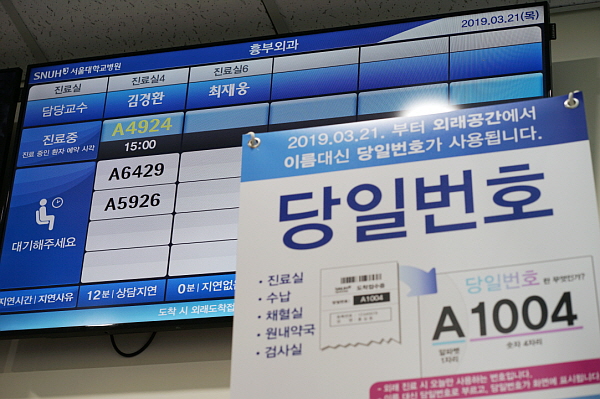
가장 고전적이지만 확실한 방법입니다. 접수 시 환자에게 번호표를 발급하고, 진료실 앞 모니터나 음성으로 해당 번호를 호출하는 방식입니다. 서울대학교병원은 이미 2019년 대한외래 개원과 함께 환자 이름 대신 '고유번호'로 호명하는 방식을 도입한 바 있습니다.43 이는 병원의 편의주의를 벗어나 환자의 프라이버시를 존중하려는 초기 노력으로 평가할 수 있습니다.
B. 대안 2: '진동벨(페이저)' (카페식 모델)
카페식 진동벨(페이저)은 특히 환자의 동선이 복잡하거나 대기 공간이 협소한 병원에서 매우 효과적으로 사용되고 있습니다.
·(사례 연구: 수원 이안과) 안과와 같이 접수, 문진, 다수의 검사, 진료, 수납 등 여러 단계를 거쳐야 하는 병원은 환자가 길을 잃기 쉽습니다. 수원 이안과는 '스태프콜 진동벨'을 도입하여 이 문제를 해결했습니다.44 이 시스템의 핵심은 단순한 진동 호출이 아니라, 진동벨에 부착된 '스크린을 통한 안내' 기능입니다.44 환자의 진동벨에 "2층 문진1로 가세요", "검사실로 가세요", "수납 창구로 가세요"와 같이 다음 단계의 장소가 텍스트로 표시됩니다.44 이는 환자가 헤매지 않도록 안내하는 '개인 네비게이터' 역할을 수행하며 프라이버시를 완벽하게 보호합니다.
·(사례 연구: 명지성모병원) 이 병원은 본관과 떨어진 외부 주차타워에서 출차를 대기하는 환자들을 위해 진동벨을 도입했습니다.45 환자들은 춥거나 더운 외부 주차 데스크가 아닌 병원 내에서 편안하게 대기하다가, 진동벨이 울리면 차를 타러 나갈 수 있습니다. 이는 프라이버시 보호뿐 아니라 환자 만족도를 높이는 서비스 개선 사례입니다.
C. 대안 3: '스마트 대기 시스템' (통합 모델)
현재 국내 대형병원들을 중심으로 가장 고도화되고 있는 방식은 키오스크, 대기실 모니터, 의료진 PC, 그리고 환자 모바일 앱까지 하나로 연동하는 '스마트 대기 시스템'입니다.
4C Gate 42나 DID Bank 46 같은 전문 솔루션 업체들은 이미 다수의 상급종합병원에 '지능형 순번대기 시스템'을 구축했습니다.42 이 시스템의 작동 방식은 다음과 같습니다.
1. 접수: 환자가 병원에 도착하면, 키오스크나 자신의 '환자용 모바일 앱'47을 통해 진료카드 등록 및 도착 확인(접수)을 합니다.
2. 대기: 대기실에 설치된 대형 '환자용 디스플레이'46에 'OOO번' 또는 '홍O동'과 같이 익명화된 대기 환자 목록이 실시간으로 표시됩니다.
3. 호출: 의사는 진료실 자신의 PC에 설치된 '의사용 미니앱'46을 통해 현재 대기열을 확인하고, 다음 환자를 클릭하여 호출합니다.
4. 안내: 의사의 호출 신호는 즉시 대기실 디스플레이와 스피커로 전송되어 "123번 환자님, 3번 진료실로 들어오십시오"와 같은 시각적, 청각적 안내가 나옵니다.
이 통합 모델은 영국 NHS의 EMR 연동 호출 시스템 33과 매우 유사합니다. 간호사가 복도를 돌아다니며 환자 이름을 부를 필요 없이, 의료진의 PC와 대기실이 직접 연동되어 '프라이버시 보호'와 '병원 운영 효율성'이라는 두 마리 토끼를 동시에 잡는 최적의 대안입니다.
IV. 모두를 위한 의료 서비스: 기술과 포용의 균형점
A. '디지털 약자'의 장벽: 키오스크가 주는 위축감
하지만 "키오스크 방식은 어르신들한테 부담"이라고 지적하신 부분은 이러한 기술 도입의 가장 큰 딜레마이자 반드시 해결해야 할 과제입니다.
기술의 발전이 때로는 고령층이나 디지털 기기에 익숙하지 않은 '디지털 약자'에게 식당 주문이나 병원 접수조차 못 하게 만드는 '새로운 차별의 장벽'이 될 수 있습니다.48 이는 환자에게 또 다른 위축감과 자존감 하락을 유발합니다. 단순히 인건비를 줄이기 위해 키오스크만 설치하고 직원을 없애는 것은, '병원의 편의주의'가 아날로그(이름 호명)에서 디지털(키오스크 강요)로 형태만 바꾼 것에 불과합니다.
B. 대안: '하이브리드' 모델과 '인적 서비스'의 결합
이 문제의 해결책은 '약자 입장에서 생각하는' 포용적 설계에 있습니다.
·키오스크 + 직원 병행 (하이브리드 모델): 키오스크를 도입하더라도 반드시 '직원 접수 창구'를 병행 운영해야 합니다. 전북대학교병원의 키오스크 안내 영상에서도 "대리진료 또는 서류를 가지고 내원하는 경우에는 직원에게 문의"하라고 명시되어 있듯이 49, 복잡한 업무나 디지털 약자를 위한 인적 대응 채널은 필수적입니다.
·안내 인력(디지털 도우미) 배치: 서울 강서구가 구청 민원실에 '스마트 통합 순번대기시스템'을 도입하면서, 키오스크 사용이 익숙하지 않은 주민들을 위해 '현장 안내도우미'를 배치한 사례 50는 병원이 반드시 벤치마킹해야 합니다.
C. 기술을 통한 포용: '쉬운 기술'의 개발
나아가 기술은 약자를 배제하는 것이 아니라 포용하는 방향으로 발전해야 합니다.
·최근에는 70대 이상 고령층도 쉽게 사용할 수 있도록 가상 직원이 음성으로 안내하는 'AI 메타휴먼 안내 키오스크' 51나 '쉬운 키오스크' 기술이 개발되어 병원에 적용되고 있습니다.
·또한, 대웅제약이 의료 접근성이 떨어지는 도서 지역(육도) 주민들을 위해 '이동형 검진소'에 웨어러블 심전도 기기, AI 실명질환 진단 솔루션 등을 탑재하여 찾아가는 의료를 실현한 사례 52나, 독거노인을 위한 AI 건강관리 로봇 '다솜이' 53 사례는, 디지털 기술이 오히려 '약자'를 더욱 세심하게 배려하고 의료 사각지대를 해소하는 강력한 포용의 도구가 될 수 있음을 증명합니다.
V. 결론: '편의'가 아닌 '안전'과 '존중'을 위한 호출 시스템을 향하여
병원 대기실에서 환자의 이름과 생년월일을 공개적으로 호명하는 한국의 관행은, 환자의 심리적 존엄성을 훼손할 뿐만 아니라 보이스피싱과 같은 2차 범죄에 악용될 수 있는 심각한 개인정보 노출 위험 2을 안고 있습니다. 2024년 5월 도입된 '요양기관 본인확인 의무화 제도' 9는 접수 단계에서 신분증을 통한 비공개 확인을 강화했으므로, 대기실에서의 '공개 호명' 관행을 지속할 명분을 오히려 약화시켰습니다.
미국(HIPAA)의 '최소 필요 원칙'에 입각한 '이름 + 성 첫 글자' 호출 23, 영국(NHS)의 EMR 연동 '시각적 TV 호출' 33, 일본 병원들의 '개인정보 보호'를 위한 '번호 호출'로의 적극적인 전환 36, 그리고 중국의 '모바일 앱 호출'을 통한 대기 시간 단축 41 사례는, 이미 많은 선진국이 이 문제를 해결했음을 보여줍니다.
국내에서도 서울대병원의 '고유번호' 도입 43, 수원 이안과의 '안내 진동벨' 44, 그리고 다수 상급종합병원의 '스마트 대기 시스템' 42 등 기술적, 정책적 대안은 이미 마련되어 있습니다.
이에 다음과 같이 제언합니다.
1.'익명 환자 호출'의 전면 도입: 모든 병·의원은 '동명이인 확인'이라는 병원의 편의주의적 관행을 중단하고, '번호표', '고유번호', '진동벨' 또는 '스마트 대기 시스템' 등 환자 프라이버시를 보호하는 익명 호출 시스템을 전면 도입해야 합니다.
2.'하이브리드 시스템'의 의무화: 키오스크 등 무인 기술 도입 시, 반드시 고령층과 디지털 약자를 위한 '직원 병행 창구' 및 '안내 도우미' 배치를 의무화하여 '포용적 설계'를 갖추어야 합니다.50
3.인식의 전환: 의료는 서비스입니다. 환자 호출 방식의 개선은 추가 비용이 드는 '선택적 편의'가 아니라, 환자의 개인정보 '안전'과 인간적 '존엄성'을 지키는 의료 서비스의 가장 기본적인 책무임을 인식해야 합니다.
"When My Name is Called in Front of the Consultation Room: Is Waiting Room Privacy in Hospitals Still Acceptable?" - A Comparative Analysis of Advanced Countries and the Search for Inclusive Alternatives
I. Introduction: "Mr. Hong, Born January 1, 1990, Is That Correct?" - The Privacy Dilemma in Hospital Waiting Rooms
A. Raising the Issue: The Hospital Waiting Room as a Stage for Public Data Exposure
When we visit a hospital, we are often already in a psychologically vulnerable state due to illness or injury. In this situation, the experience of a staff member loudly calling our name, "Mr. Hong," and asking for confirmation, "Born on January 1, 1990, is that correct?" in front of the reception desk or consultation room, causes discomfort and anxiety for many.
This is not a simple matter of inconvenience. A name and date of birth are core Personally Identifiable Information (PII). When combined with sensitive medical information, they must be protected even more strictly. Especially for sensitive departments like gynecology, urology, or mental health, where one may not wish to publicize their visit, having one's name called in the waiting room can be experienced as extreme stress and a privacy violation.
This practice directly contradicts the modern perspective of "healthcare as a service." The very medical institutions that should be protecting patient dignity and providing psychological stability are, for the sake of operational convenience, publicly exposing patients' sensitive information in the public space of a waiting room.
B. The Risk of Secondary Damage: The Potential for Misuse of Information Gathered in Waiting Rooms
A more serious problem is that this exposed personal information can be exploited for secondary crimes. A voice phishing scenario, such as, "Hello, Mr. Hong? Born January 1, 1990, correct? We are calling from the hospital you recently visited..." is a very realistic threat.
The hospital and medical industry is already a prime target for hacking and ransomware attacks.1 Incidents of patient names, IDs, phone numbers, and emails being leaked are frequent.2 If a criminal organization combines "phone numbers" obtained through hacking with the "names and dates of birth" that anyone can easily overhear in a hospital waiting room, it creates a "complete dataset" that dramatically increases the credibility of a scam call.
In other words, the practice of "publicly calling" in waiting rooms can serve as the "final puzzle piece" that maximizes the damage from a data breach and increases the success rate of secondary crimes like voice phishing.5 The hospital, which should be protecting sensitive patient data, could instead become a channel that provides a pretext for crime.
C. The Dilemma of 'Identifying Look-alikes' and 'Mandatory ID Verification'
Hospitals may argue that this practice is a necessary measure to identify individuals with the same name and ensure patient safety. Of course, patient identification is one of the most critical procedures in medical safety.
However, with the revision of the National Health Insurance Act, effective May 20, 2024, hospitals and clinics are now required to verify a patient's identity and eligibility using an ID card, mobile health insurance card, or other means.8 The original intent of this system is to block cases of identity theft or fraudulent use of health insurance.8
Paradoxically, the implementation of this law reduces the need for "public calling," rather than justifying it. The core of the law is to 'privately and accurately' verify identity at the reception desk using tools like an ID card or a mobile health app QR code.10
Once this enhanced identity verification is completed at the reception stage, the necessity of publicly shouting the patient's sensitive 'full name and date of birth' during the waiting and calling stages is significantly diminished. Hospitals should not use "mandatory ID verification" as an excuse to justify their existing convenient practice. Instead, they should use this system as an opportunity to improve the entire process: "private verification at reception" + "anonymous calling while waiting."
II. Privacy Protection in Advanced Countries: How Do Foreign Hospitals Call Patients?
How do other advanced countries handle this problem? Most have strong legal regulations and technological alternatives to protect patient privacy in waiting rooms.
A. United States (HIPAA): Applying the 'Minimum Necessary' Principle
Legal Basis (HIPAA): The U.S. healthcare system is strictly regulated by the Health Insurance Portability and Accountability Act of 1996 (HIPAA).13 This law strongly controls the use and disclosure of a patient's "Protected Health Information (PHI)".15
Application in Waiting Rooms: HIPAA does not prohibit the act of calling a patient's name in a waiting room, recognizing the realities of clinical workflow. This is considered an "Incidental Disclosure" and is permitted to an extent.17
Core Principle (Minimum Necessary): However, this allowance is contingent on adhering to "Reasonable Safeguards" 19 and the "Minimum Necessary Standard".22 This means that only the minimum information required to achieve the purpose (calling the patient) should be used.
Real-World Application:
· Following this principle, most U.S. hospitals do not call out a patient's full name. The most common practice is to call the "First Name + Last Initial" (e.g., "Michael K.").22
· Other methods include using the "First Name + Middle Initial" or even asking the patient at check-in, "How would you like to be called in the waiting room?" and recording that preferred name (or nickname) in the chart.23
· The Korean practice of publicly shouting the 'full name' and 'six-digit date of birth' would very likely violate HIPAA's "Minimum Necessary Standard."
· Furthermore, many hospitals use digital signage in waiting rooms to provide information like estimated wait times or health tips, reducing patient anxiety.24 Major hospitals like the Mayo Clinic 25 and Johns Hopkins 26 use patient portals (My Portal) to support appointment confirmation and communication, minimizing confusion in the waiting area.
B. Europe (GDPR) and United Kingdom (NHS): Strict Protection that Considers 'Context'
Legal Basis (GDPR): Europe's General Data Protection Regulation (GDPR) classifies health data as a "special category of data" (sensitive data), demanding the highest level of protection.27
Sensitivity of Calling Names (Context Matters): From a GDPR perspective, calling a patient's name can be a-serious privacy breach depending on the 'context.' For example, in a specialized clinic where all patients are treated for the same disease (e.g., Hepatitis B, HIV), calling a name publicly reveals that the named person has that specific condition. This poses a high risk of violating GDPR.29 Therefore, the most common and safest alternative in Europe is a "number ticket system," similar to a bank.29
(Case Study: Poland) Privacy vs. Patient Safety: To comply with GDPR, Poland introduced strict provisions in its national law that banned the public calling and posting of patient names in hospitals.30 However, this immediately met with strong criticism from the medical field. Healthcare staff argued that it hindered patient identification, increased the risk of medical errors, and delayed responses in emergencies, thereby threatening "patient safety".30 As a result, the law was amended to balance these concerns: privacy in the waiting room was maintained, but clear identification (name on wristbands and medicine containers) was ensured, demonstrating a balance between 'waiting room privacy' and 'clinical safety.'
(Case Study: UK NHS) Integrated Technical Standards: The UK adheres to the UK GDPR 31, and its technological alternatives for patient calling are highly standardized.
· Visual Calling System: Patient calling systems like 'Envisage' are widely adopted in GP (General Practitioner) practices.33 This system uses a TV screen in the waiting room to visually and audibly call the patient (e.g., "Number 000, please go to Consulting Room 2").33
· System Integration: The key feature is that this calling system is fully integrated with the doctor's EMR (Electronic Medical Record) system (e.g., EMIS, TPP SystmOne).33 When the doctor clicks on the next patient on their PC, the call information is automatically sent to the waiting room TV.
· Use of Pagers: Paging systems (vibrating bells), which give patients the freedom to wait in the hospital cafe or other areas, are also actively used.35
C. Japan: Switching to 'Number Calling' for 'Personal Information Protection'
In Japan, as awareness of personal information protection has grown, hospitals are actively changing their patient calling methods.
· (Case Study: Katsuyama Hospital) A prime example, Katsuyama Hospital officially announced that starting Monday, June 3, 2024, it would change its method for calling outpatients. The explicit reason given was "from the perspective of personal information protection" (個人情報保護の観点から), stating they would use the patient's "reception number" (受付番号) instead of their name.36 This is a clear alternative to the current practice in Korean hospitals. (They do, however, make an exception to call the name if there is no response to the number).36
· Technology Adoption: Japanese hospitals commonly use commercialized patient pagers ("One-Touch Call" 37) and number ticket issuing systems.38 Privacy principles are strongly enforced, extending to not revealing medical information to family members over the phone.39
D. China: 'Number Calling' as Standard and 'Mobile Innovation'
Standard Procedure (Number Calling): In local Chinese hospitals, such as in Shanghai, the standard procedure is to register, receive a 'number ticket,' and enter the consultation room 'when the number is called'.40 In short, 'number calling' is already the standard practice.
(Case Study: Shanghai Children's Hospital) Mobile Innovation: China has taken this a step further with mobile app innovation. The Shanghai Children's Hospital integrated its patient calling system with the 'WeChat' app.41 Patients no longer need to wait endlessly in the hospital; they can check their real-time queue status on their smartphone and receive the call via the app.
The results of this system go beyond just privacy. Its introduction dramatically reduced the average patient wait time from 126 minutes to just 33 minutes—a 93-minute reduction.41 It also maximized hospital operational efficiency by reducing unnecessary nurse idle time.41 This is a model case that solves privacy, efficiency, and patient satisfaction simultaneously, representing a next-generation alternative beyond the pager.
Table 1: Comparison of Hospital Patient Calling Methods and Legal Bases by Country
| Country | Key Legal Basis | Common Calling Method | Key Technology & Features | Privacy Protection Level |
| South Korea | Personal Info. Protection Act, Medical Act | Full Name + Date of Birth (Publicly) | - (Customary)- Some large hospitals adopting smart systems 42 | Very Low |
| United States | HIPAA | First Name + Last Initial (Min. Necessary) 23 | Digital Signage 24, Patient Portals 25 | Medium (Pragmatic Compromise) |
| Europe (GDPR) | GDPR | Number Calling (Safest) 29 | (Poland) Debate on Privacy vs. Safety 30 | Very High |
| UK (NHS) | UK GDPR | Visual Calling (TV Screen) / Number 33 | EMR-Integrated TV Call 33, Pagers 35 | High (Technically Standardized) |
| Japan | Personal Info. Protection Act | Number Calling (Actively transitioning) 36 | Number Tickets 38, Pagers 37 | High (Privacy-Centric) |
| China | (Relevant Laws) | Number Calling (Standard) 40 | WeChat Mobile Calling (Advanced) 41 | High (Process Standardized) |
III. The Current State of Korean Hospitals: Already-Started Changes and Alternatives for 'Anonymous Calling'
As seen in the international examples, alternatives to protect patient privacy already exist. Surprisingly, many of these systems have already been successfully introduced and are operational in various Korean hospitals.
A. Alternative 1: 'Unique ID' and 'Waiting Number' (Bank Model)
This is the most classic but reliable method. A number ticket is issued at reception, and that number is called via a monitor or voice announcement. Seoul National University Hospital, for instance, already introduced a system to call patients by a "unique number" instead of their name back in 2019.43 This can be evaluated as an early effort to respect patient privacy beyond hospital convenience.
B. Alternative 2: 'Vibrating Pager' (Cafe Model)
The cafe-style vibrating pager is already being used very effectively in Korean hospitals, especially those with complex patient flows or limited waiting space.
· (Case Study: Suwon E-An Eye Clinic) In clinics like ophthalmology, where patients must go through multiple steps (reception, consultation, multiple tests, treatment, payment), it is easy to get lost. The Suwon E-An Clinic solved this by introducing the 'Staff Call Pager'.44 The core of this system is not just the vibration, but the 'guidance via screen' function.44 The patient's pager displays text for the next step, such as "Go to 2nd Floor, Consultation 1," "Go to Test Room," or "Go to Payment".44 This acts as a 'personal navigator,' ensuring the patient doesn't get lost while perfectly protecting their privacy.
· (Case Study: Myongji St. Mary's Hospital) This hospital introduced pagers for patients waiting for their cars at the external parking tower, which is separate from the main building.45 Patients can wait comfortably inside the hospital instead of at the cold or hot outdoor parking desk, and then go to their car when the pager vibrates. This is a case of improving patient satisfaction as well as protecting privacy.
C. Alternative 3: 'Smart Queuing System' (Integrated Model)
The most advanced method currently being implemented, primarily in large Korean hospitals, is the 'Smart Queuing System,' which integrates kiosks, waiting room monitors, medical staff PCs, and even patient mobile apps.
Specialized solution providers like 4C Gate 42 and DID Bank 46 have already built "Intelligent Queuing Systems" in numerous major general hospitals.42 The workflow of this system is as follows:
1. Check-in: Upon arrival, the patient uses a kiosk or their 'patient mobile app' 47 to register their medical card and confirm their arrival.
2. Wait: On the large 'Patient Display' screen in the waiting room 46, an anonymized waiting list (e.g., "Number 000" or "Hong O-dong") is displayed in real-time.
3. Call: The doctor views the current queue on a 'Mini-App' on their own PC 46 and calls the next patient with a click.
4. Notify: The doctor's call signal is immediately sent to the waiting room display and speakers, providing visual and audio guidance like, "Patient 123, please proceed to Consultation Room 3."
This integrated model is very similar to the UK NHS's EMR-linked calling system.33 It eliminates the need for nurses to walk the halls calling names and achieves both 'privacy protection' and 'operational efficiency' by directly linking medical staff PCs to the waiting room.
IV. Healthcare for All: The Balance Point of Technology and Inclusion
A. The Barrier for the 'Digitally Vulnerable': The Intimidation of Kiosks
However, your point that "kiosks are a burden for the elderly" is the biggest dilemma of this technological shift and a problem that must be solved.
Technological advancement can sometimes become a 'new barrier of discrimination' for the elderly or those unfamiliar with digital devices, preventing them from even ordering food or checking in at a hospital.48 This can cause further psychological distress and a loss of self-esteem. Simply installing kiosks to cut labor costs and eliminating staff is not a solution; it is merely 'hospital convenience' shifting its form from analog (calling names) to digital (forcing kiosks).
B. The Solution: A 'Hybrid' Model and the Combination of 'Human Service'
The solution to this problem lies in inclusive design that "thinks from the perspective of the vulnerable."
· Kiosk + Staff (Hybrid Model): Even when introducing kiosks, a 'staffed reception window' must be operated in parallel. As the kiosk guide from Jeonbuk National University Hospital explicitly states, "for proxy visits or document requests, please contact a staff member".49 A human channel for complex tasks and for the digitally vulnerable is essential.
· Deploying Guides (Digital Helpers): The case of Seoul's Gangseo-gu Office, which deployed 'on-site guides' to help residents unfamiliar with kiosks when it introduced its 'Smart Integrated Queuing System' 50, is a model that hospitals must benchmark.
C. Inclusion Through Technology: The Development of 'Easy Tech'
Furthermore, technology must evolve not to exclude the vulnerable, but to include them.
· Recently, 'Easy Kiosks' or 'AI Metahuman Guide Kiosks' 51 are being developed and applied in hospitals, using virtual assistants and voice guidance to be easily usable even by seniors in their 70s.
· Moreover, cases like Daewoong Pharmaceutical's "mobile check-up center" 52, which uses wearable ECGs and AI diagnostic solutions to provide healthcare to remote island residents, or the 'Dasomi' AI care robot for isolated seniors 53, prove that digital technology can be a powerful tool for inclusion, enhancing medical access and filling in the gaps for the vulnerable.
V. Conclusion: Toward a Calling System for 'Safety' and 'Respect,' Not 'Convenience'
The Korean custom of publicly calling a patient's name and date of birth in a hospital waiting room not only damages the patient's psychological dignity but also carries the serious risk of personal information exposure 2 that can be exploited for secondary crimes like voice phishing. The 'Mandatory ID Verification System' introduced in May 2024 9 reinforces private verification at the reception stage, thereby weakening the justification for continuing the 'public calling' practice.
The examples from advanced countries—the US (HIPAA) 'First Name + Last Initial' call 23, the UK (NHS) EMR-linked 'Visual TV Call' 33, Japanese hospitals' active transition to 'Number Calling' for 'privacy protection' 36, and China's 'Mobile App Calling' to reduce wait times 41—all show that this problem has already been solved elsewhere.
In Korea, the technological and policy alternatives are already in place, from SNU's 'unique numbers' 43 and Suwon E-An Clinic's 'guide pagers' 44 to the 'Smart Queuing Systems' in many major hospitals.42
Therefore, the following is proposed:
1. Full Adoption of 'Anonymous Patient Calling': All hospitals and clinics must cease the 'hospital convenience'-driven practice of calling names and fully adopt anonymous calling systems that protect patient privacy, such as 'number tickets,' 'unique IDs,' 'pagers,' or 'smart queuing systems.'
2. Mandate 'Hybrid Systems': When introducing unmanned technology like kiosks, an 'inclusive design' must be mandated by law, requiring the parallel operation of 'staffed windows' and the placement of 'guides' 50 to protect the elderly and digitally vulnerable.
3. A Shift in Perception: Healthcare is a service. Improving the patient calling method is not an 'optional convenience' that costs extra; it is the most fundamental duty of a healthcare service to protect the patient's "safety" and "dignity."
#병원개인정보#환자호출방식#개인정보보호#병원대기실#HIPAA#GDPR#환자본인확인의무화#스마트병원
#병원진동벨#병원번호표#디지털약자#키오스크#의료서비스#보이스피싱#환자안전#환자존중
참고 자료
1. 유명 강남 병원도 당했다…환자 수십만 명 정보 유출 / SBS - YouTube, https://www.youtube.com/watch?v=ecGtVuOuDoQ
2. 의료업계 해킹, 랜섬웨어로 인한 개인정보 유출 - 인스피언 공식 블로그 - 티스토리,https://inspien01.tistory.com/m/entry/%EC%9D%98%EB%A3%8C%EC%97%85%EA%B3%84-%ED%95%B4%ED%82%B9-%EB%9E%9C%EC%84%AC%EC%9B%A8%EC%96%B4%EB%A1%9C-%EC%9D%B8%ED%95%9C-%EA%B0%9C%EC%9D%B8%EC%A0%95%EB%B3%B4-%EC%9C%A0%EC%B6%9C
3. 대전선병원 해킹 공격받아 고객 개인정보 유출 / YTN - YouTube,https://www.youtube.com/watch?v=A8EbVbItGIk
4. 대학병원 17곳 제약사에 18만명 환자정보 유출 - 청년의사, http://www.docdocdoc.co.kr/news/articleView.html?idxno=3008083
5. 메르스 환자에 지원금?…스미싱·보이스피싱 주의 - 대한민국 정책브리핑, https://www.korea.kr/news/policyFocusView.do?newsId=148796671&pkgId=49500629
6. 대학병원 의사들도 당한 '보이스피싱'…주의 필요 - 데일리메디, https://www.dailymedi.com/news/news_view.php?wr_id=928352
7. "카톡 검사사칭에 의사도 40억 뜯겨"...보이스피싱 주의! - 데일리팜, https://m.dailypharm.com/newsView.html?ID=291181
8. 내년부터 의료기관이 환자 신분증 본인확인 ... - MEDI:GATE NEWS, https://m.medigatenews.com/news/2011153753
9. 5월 20일부터 병·의원 진료 시 신분증을 챙겨주세요. < 전체 < 보도자료 < 알림 - 보건복지부, https://www.mohw.go.kr/board.es?mid=a10503010100&bid=0027&act=view&list_no=1481541&tag=&nPage=1
10. 20일 시행되는 환자 본인확인...병의원-의무, 약국- 제외 - 데일리팜, https://m.dailypharm.com/newsView.html?ID=311736
11. 의료기관의 수진자 본인확인 의무화 필요성, https://www.kiri.or.kr/pdf/%EC%A0%84%EB%AC%B8%EC%9E%90%EB%A3%8C/KIRI_20120608_165660.pdf
12. 요양기관 본인확인 강화 제도 Q&A, https://www.urology.or.kr/rang_board/inc/download.php?code=notice&num=15217
13. Communicating with Patients Under HIPAA and the TCPA: The Good, the Bad and the "Do-Not-Call" - Butzel Long, https://www.butzel.com/alert-Communicating-with-patients-under-hipaa-and-the-tcpa-the-good-the-bad-and-the-do-not-call
14. Protecting patient privacy | Northwell Health, https://www.northwell.edu/about-northwell/commitment-to-excellence/protecting-patient-privacy
15. Can patient telephone calls and visits be recorded? - Paubox, https://www.paubox.com/blog/can-patient-telephone-calls-and-visits-be-recorded
16. Summary of the HIPAA Privacy Rule -
HHS.gov, https://www.hhs.gov/hipaa/for-professionals/privacy/laws-regulations/index.html
17. 199-May providers use patient sign-in sheets or call out the names ..., https://www.hhs.gov/hipaa/for-professionals/faq/199/may-health-care-providers-use-sign-in-sheets/index.html
19. HIPAA Guidelines for Reception Areas | Waiting Room Compliance, https://compliancy-group.com/hipaa-waiting-rooms/
20. 202-Will HIPAA allow the hospital to display patient names outside of rooms - HHS.gov, https://www.hhs.gov/hipaa/for-professionals/faq/202/may-health-care-providers-post-names/index.html
21. Are Patient Sign-In Sheets a HIPAA Violation? - Security Metrics, https://www.securitymetrics.com/blog/are-patient-sign-sheets-hipaa-compliant
22. Real Talk: Using a Patient's Full Name in the Waiting Room - Gamma Compliance Solutions, https://support.gammacompliance.com/hc/en-us/articles/13527329289371-Real-Talk-Using-a-Patient-s-Full-Name-in-the-Waiting-Room
23. HIPAA and Calling Out Full Names In Waiting Rooms - Privacy and ..., https://privacysecuritybrainiacs.com/privacy-professor-blog/hipaa-and-calling-out-full-names-in-waiting-rooms/
24. Best practices for communicating with patients in the waiting room - PatientPoint, https://patientpoint.com/blog/best-practices-waiting-room-patient-communication/
25. Patient portal: Connect to care online - Mayo Clinic Health System, https://www.mayoclinichealthsystem.org/patient-online-services
26. Patient Privacy Information | Johns Hopkins Medicine, https://www.hopkinsmedicine.org/patient-privacy-information
27. The new EU Regulation on the protection of personal data: what does it mean for patients?,https://www.eu-patient.eu/globalassets/policy/data-protection/data-protection-guide-for-patients-organisations.pdf
28. Navigating GDPR in Healthcare: Essential Guide, https://www.gdprregister.eu/gdpr/healthcare-sector-gdpr/
29. Calling a patient's name and GDPR - Feralis, https://feralis.hr/en/centar/gdpr-teme/podaci
30. Effective communication between hospital staff and patients in ... - NIH, https://pmc.ncbi.nlm.nih.gov/articles/PMC8726447/
31. How we are protecting privacy and confidentiality - NHS England, https://www.england.nhs.uk/digitaltechnology/nhs-federated-data-platform/security-privacy/how-we-are-protecting-privacy-and-confidentiality/
32. How the NHS handles your personal health information, https://www.nhsinform.scot/care-support-and-rights/health-rights/confidentiality-and-data-protection/how-the-nhs-handles-your-personal-health-information/
33. Envisage | Patient Check-in, Waiting Room TV & Patient Call System, https://www.envisagecoda.co.uk/
34. Envisage Waiting Room TV & Patient Call - EMIS Health,https://www.emishealth.com/partners/patient-call-and-arrival-systems/envisage-waiting-room-tv-patient-call
35. NHS Healthcare Patient Pagers Hospital Paging Systems, https://pager.co.uk/healthcare_nhs.htm
36. 外来診療時における呼び出し方法の変更について | 勝山病院, https://www.katsuyama-hp.or.jp/post-4063/
37. Patient Call System "One-Touch Call" パシフィック湘南 | IPROS GMS, https://mono.ipros.com/en/product/detail/2000627273/
38. クリニック 病院 順番受付システム アイリスト|番号札 整理券発行, https://www.ilist.jp/hp/index.php/case_study_medical_clinics/
39. 個人情報保護担当委員会 編著 - 全日本病院協会, https://www.ajha.or.jp/about_us/nintei/pdf/060929.pdf
40. 중국 현지 병원에서 진료받는 방법_보건의료, https://korean.shanghai.gov.cn/ko-Healthcare/20240326/1edde16fc9784fd49906217d0e389895.html
41. Improvement in outpatient services using the WeChat calling system ...,https://pmc.ncbi.nlm.nih.gov/articles/PMC8281187/
42. 2021년 현재 90개 (상급) 종합병원에서 5,000여대의 시스템 가동, https://www.4cgate.com/history-2-2/
43. 환자 이름 대신 고유번호로 호명 - 병원신문,https://www.khanews.com/news/articleView.html?idxno=142251
44. 병원 스태프콜 진동벨 납품사례 - 수원 이안과 : 진동벨의 원조 리텍 ..., https://leetekorea.com/news/?bmode=view&idx=167703380
45. STAR 진동벨 납품사례 - 명지성모병원 주차타워 - 리텍, https://leetekorea.com/news/?bmode=view&idx=167455740
46. 병원 진료대기 솔루션 | EasySign Call Man Signage - 디아이디뱅크, https://didbank.co.kr/easysign-call-man-signage/
47. 환자용 의료진용 모바일앱 솔루션 - 포씨게이트, https://www.4cgate.com/mobile/
48. [오피니언] 노인 키오스크 문제 더 이상 미룰 수 없다. - 한세대학교, https://ipsi.hansei.ac.kr/bbs/vision/563/26518/artclView.do
49. 전북대학교병원 진료접수 키오스크 사용법 안내 - YouTube, https://www.youtube.com/watch?v=r2EFkiWMMmc
50. 강서구, 민원실에 '스마트 통합 순번대기시스템' 도입 - 뉴시스, https://mobile.newsis.com/view/NISX20220504_0001859816
51. 식당 키오스크는 어렵다? 병원 키오스크는 쉽다! - 힐팁, http://www.healtip.co.kr/news/articleView.html?idxno=7628
52. 디지털 헬스케어, 의료 사각지대를 넘다... 기술로 만든 포용의 현장, https://www.dginclusion.com/news/articleView.html?idxno=850
53. 원더풀플랫폼-일산병원-세림티에스지 "7월 K-디지털 뉴딜"사례로 꼽혀 - 스마트투데이, https://www.smarttoday.co.kr/news/articleView.html?idxno=21458


