1.4 후퇴의 전략적 해부: 정보 실패의 구조, 지휘 책임, 그리고 반사실적 역사의 조명
서문: 승리의 정점에서 맞이한 역설적 붕괴와 전략적 철수
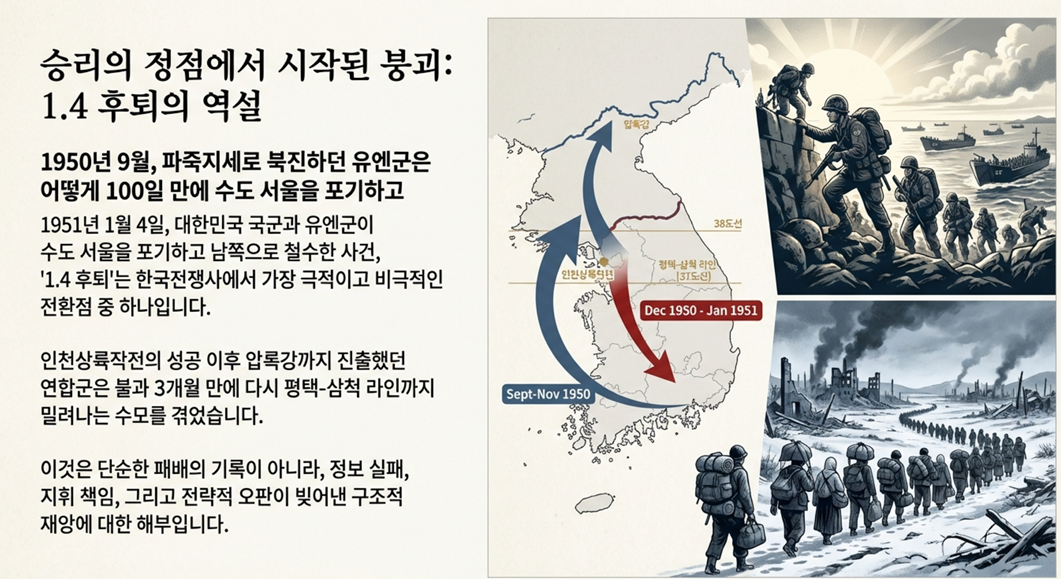
1951년 1월 4일, 대한민국 국군과 유엔군(UN군)이 수도 서울을 포기하고 남쪽으로 철수한 사건,
통칭 '1.4 후퇴'는 한국전쟁사에서 가장 극적이고 비극적인 전환점 중 하나로 기록되어 있습니다.
1950년 9월 인천상륙작전의 성공 이후 파죽지세로 북진하여 압록강과 두만강 유역까지 진출했던 연합군은 불과 3개월 만에 다시 37도선(평택-삼척 라인)까지 밀려나는 수모를 겪어야 했습니다.1
본 보고서는 단순한 전황의 기록을 넘어, 당시 지휘부가 왜 후퇴라는 극단적 선택을 할 수밖에 없었는지에 대한 군사적, 지정학적 배경을 면밀히 분석합니다. 또한, 전쟁의 향방을 바꿀 수 있었던 결정적 정보들이 어떻게 무시되었는지(정보의 비대칭), 그리고 만약 당시 다른 전략적 판단을 내렸다면 역사는 어떻게 전개되었을지(Counterfactual History)에 대해 심층적으로 고찰하고자 합니다.
특히, 맥아더 사령부의 정보 참모부와 현장 지휘관들 사이의 정보 비대칭이 초래한 재앙적 결과를 규명하고, 현대 군사 전략과 정보 분석에 주는 함의를 도출할 것입니다.
제1부: 1.4 후퇴의 역사적 및 전략적 배경
1.1 승리감에 도취된 북진과 전략적 공백
1950년 10월, 국군과 유엔군은 38선을 돌파하여 북진을 감행했습니다.
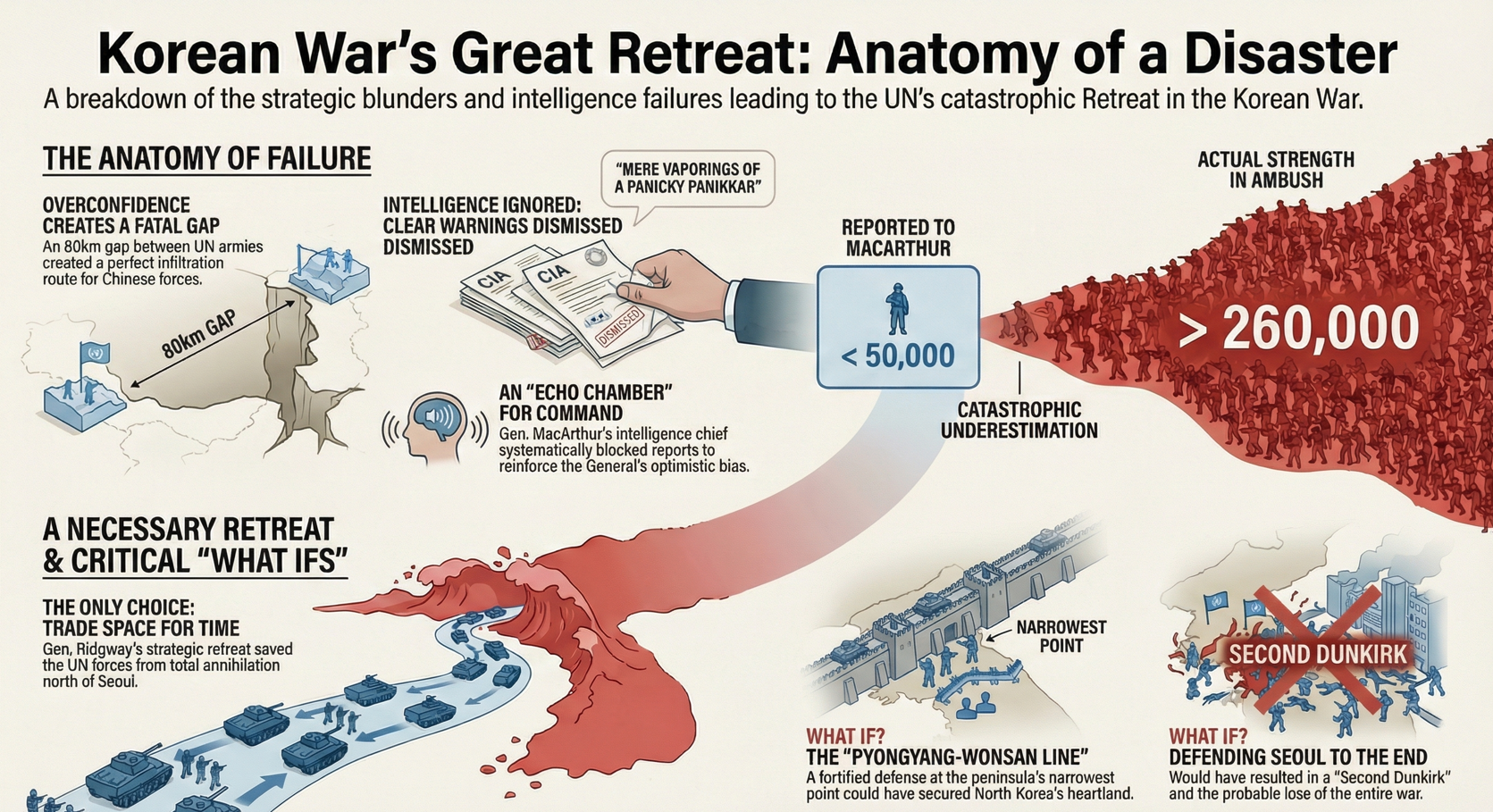
당시 도쿄의 유엔군 사령부는 북한 정권의 붕괴를 기정사실화하고 있었으며, 맥아더 원수는 "크리스마스는 고향에서(Home by Christmas)"라는 낙관적인 구호 아래 병력을 북쪽으로 분산 배치하고 있었습니다.2 이러한 낙관론은 전선의 무리한 확장을 초래했습니다. 서부전선의 미 제8군과 동부전선의 미 제10군단(X Corps) 사이에는 험준한 낭림산맥이 가로놓여 있어 약 80km에 달하는 거대한 간격(Gap)이 발생했습니다.3 이 공간은 상호 지원이 불가능한 전술적 사각지대였으며, 훗날 중공군이 침투하여 유엔군을 각개격파하는 결정적인 통로가 되었습니다.
1.2 중공군의 은밀한 개입과 기동전의 충격
이미 북한군(KPA)은 낙동강 전선과 인천상륙작전 이후 주력 부대가 궤멸된 상태였으나, 마오쩌둥은 10월부터 대규모 병력을 압록강 너머로 은밀히 투입하고 있었습니다.1 중공군(중국인민지원군, PVA)은 유엔군의 화력 우위를 무력화하기 위해 철저한 야간 기동과 산악 침투, 그리고 매복과 포위를 주전술로 삼았습니다. 그들은 낮에는 숲속에 은폐하고 밤에만 이동하며 유엔군의 항공 정찰을 따돌렸습니다.4 1950년 10월 말의 제1차 공세는 일종의 경고였으나, 유엔군은 이를 소규모 의용군의 산발적 저항으로 과소평가했습니다. 이어지는 11월 말의 제2차 공세(청천강 전투, 장진호 전투)에서 중공군은 유엔군의 측면을 완전히 포위하며 궤멸적인 타격을 입혔습니다.2
1.3 서울 포기의 전략적 불가피성: 공간과 시간을 맞바꾸다
1950년 12월 말, 중공군의 제3차 공세(신정 공세)가 임박했을 때, 전선은 이미 38선 부근까지 밀려난 상태였습니다. 당시 미 제8군 사령관으로 부임한 매튜 리지웨이(Matthew B. Ridgway) 중장은 전선을 시찰한 후 냉혹한 현실을 마주했습니다.
1.전력의 붕괴: 국군 사단들은 장비와 훈련 부족으로 중공군의 심리전과 포위 전술에 취약하여 방어선이 곳곳에서 뚫리고 있었습니다.6
2.포위의 위협: 서부 전선의 붕괴는 미군 주력 부대의 측면 노출을 의미했으며, 서울을 고수하려다가는 한강 이북에서 주력 부대가 고립되어 섬멸될 위험이 컸습니다.
3.정치적 상징성 대 군사적 실리: 리지웨이 장군은 서울이라는 정치적 상징성을 포기하는 한이 있더라도, 군사적 역량을 보존하여 후일 반격의 발판을 마련하고자 했습니다. 이는 "공간을 내어주고 시간을 벌며 주력 부대를 보존한다(Trading space for time and force preservation)"는 고도의 전략적 결단이었습니다.1
| 구분 | 1950년 12월 당시 상황 | 1.4 후퇴 결정의 전략적 근거 |
| 전선 상황 | 38선 부근 방어선 불안정, 국군 사단 와해 직전 | 현 위치 고수 시 주력 부대 포위 및 섬멸 위험 |
| 적군 전력 | 중공군 3차 공세 시작, 수적 우위 및 심리적 압박 | 중공군의 보급선 연장 유도 및 공세 종말점 도달 대기 |
| 아군 상태 | 사기 저하, 보급 혼선, 지휘관 교체(워커 사망 → 리지웨이) | 부대 재편성 및 전투 의지 회복을 위한 시간 필요 |
| 핵심 목표 | 서울 사수 (정치적 목표) | 유엔군 전력 보존 (군사적 목표) |
제2부: 정보의 비대칭과 조직적 무시(Ignorance)가 초래한 비극
1.4 후퇴라는 비극적 결과의 이면에는 명백한 경고 신호들을 조직적으로 무시한 정보 실패가 자리 잡고 있습니다. 이는 정보가 부족해서가 아니라, 존재하는 정보를 지휘부의 입맛에 맞게 해석하거나 무시한 '확증 편향(Confirmation Bias)'과 정보의 정치화가 빚어낸 참사였습니다.
2.1 K.M. 파니카의 경고: 무시된 외교적 시그널
인도 대사 K.M. 파니카(K.M. Panikkar)는 베이징에서 주은래(Zhou Enlai)와 회동하며 중공의 참전 의사를 서방 세계에 전달하는 유일하고도 핵심적인 통로였습니다. 1950년 10월 2일 자정, 주은래는 파니카를 긴급 호출하여 "미군이 38선을 넘는다면 중국은 개입할 것"이라고 명확히 경고했습니다.7 파니카는 이를 본국과 서방에 즉각 타전하며 "미국이 고의적으로 전쟁을 선택했다"고 우려를 표명했습니다.8
그러나 워싱턴과 도쿄의 반응은 냉소적이었습니다.
·딘 애치슨(Dean Acheson) 미 국무장관: 파니카의 경고를 "겁에 질린 파니카의 허풍(mere vaporings of a panicky Panikkar)"이라며 일축했습니다.8 서방 지도자들은 파니카가 공산주의에 유화적이라고 의심하여 그의 정보를 신뢰하지 않았습니다.
·트루먼 대통령과 맥아더 장군: 웨이크 섬 회담(1950년 10월 15일)에서 맥아더는 "중공군의 개입 가능성은 거의 없으며, 만약 개입하더라도 미 공군력에 의해 대살육(greatest slaughter)이 벌어질 것"이라고 호언장담했습니다.9
2.2 찰스 윌로비의 정보 독점과 왜곡
맥아더 사령부의 정보참모부장(G-2)이었던 찰스 윌로비(Charles Willoughby) 소장은 정보 실패의 핵심 인물로 지목됩니다. 그는 맥아더의 '북진 통일'이라는 전략적 목표를 뒷받침하기 위해 불리한 정보들을 체계적으로 배제하거나 축소했습니다.11
·정보의 축소 및 은폐: 현장 지휘관들과 CIA가 중공군의 대규모 병력 이동 징후(만주 접경 지역 병력 집결, 포로 심문 결과 등)를 보고했음에도 불구하고, 윌로비는 이를 "소수의 의용군"이나 "보안 부대" 정도로 격하했습니다. 실제로는 26만 명 이상의 중공군이 이미 압록강을 건너 매복하고 있었음에도, 윌로비는 맥아더에게 "중공군 병력은 5만 명 미만"이라는 치명적으로 잘못된 추정치를 보고했습니다.8
·보고 체계의 차단: 윌로비는 맥아더가 듣고 싶어 하는 정보만을 선별하여 올렸으며, CIA나 다른 정보기관의 분석이 맥아더에게 도달하는 것을 차단했습니다. 이는 지휘관의 눈과 귀를 가리는 결과를 초래했으며, 맥아더의 오판을 강화하는 '반향실 효과(Echo Chamber Effect)'를 낳았습니다.11
2.3 CIA 및 현장 정보의 묵살
CIA는 1950년 10월 중순부터 중국의 개입 징후를 다수 포착했습니다.
·의료품 구매 및 부대 이동: 중국이 대량의 의료품을 해외에서 구매하고 있으며, 만주 지역에 30만 명 이상의 병력이 집결했다는 첩보가 있었습니다.10
·포로 심문: 1950년 10월 말, 미군은 중공군 정규군 포로를 생포하여 그들이 조직적인 부대 단위로 투입되었음을 확인했습니다.12
그러나 윌로비와 맥아더 사령부는 이러한 명백한 증거들을 "개별적인 지원병" 수준으로 해석하며 전략적 의미를 축소했습니다. 이는 "정보 실패라기보다는 정보 관리의 실패"에 가까웠습니다.8
제3부: 책임의 소재 - 전략적 오판과 리더십의 부재
1.4 후퇴를 초래한 책임은 특정 개인에게만 전가할 수 없는 복합적인 문제였으나, 당시 주요 지휘관들의 결정적인 실책과 리더십의 부재는 분명하게 규명될 수 있습니다.
3.1 더글러스 맥아더 원수: 오만과 전략적 근시안
맥아더는 인천상륙작전의 성공에 도취되어 전장을 객관적으로 보지 못했습니다.
·병력 분산의 오류: 한반도 북부의 지형적 특성(낭림산맥)을 무시하고 병력을 서부(8군)와 동부(10군단)로 나누어 진격시키는 전략적 실수를 범했습니다. 두 부대 사이의 거대한 간격은 중공군에게 완벽한 침투로를 제공했습니다.3
·현실 부정과 책임 회피: 중공군의 개입이 확인된 이후에도 즉각적인 방어 태세 전환 대신 공세를 고집하여 아군의 피해를 키웠습니다. 사태가 악화되자 그는 워싱턴의 정책 탓으로 돌리며 책임을 회피하려 했고, 이는 결국 그의 해임으로 이어지는 원인이 되었습니다.13
3.2 에드워드 알몬드 소장: 전술적 무능과 불통
맥아더의 최측근이자 10군단장이었던 에드워드 알몬드(Edward Almond) 소장은 전술적 무능과 부하 지휘관들과의 불화로 비판받습니다.
·무리한 진격 명령: 장진호 전투 당시, 미 해병 1사단장 올리버 스미스(O.P. Smith) 소장이 신중한 진격을 건의했음에도 불구하고, 알몬드는 지형과 기후, 적정(敵情)을 무시한 채 무조건적인 북진을 강요했습니다. 그는 "중공군은 없다"며 스미스 장군의 우려를 "패배주의"로 몰아붙였습니다.14
·테스크 포스 페이스(Task Force Faith)의 궤멸: 알몬드의 무리한 명령으로 장진호 동쪽으로 진격했던 미 육군 7사단 31연대(테스크 포스 페이스)는 중공군에 포위되어 전멸에 가까운 피해를 입었습니다. 이는 지휘관의 오판이 병사들의 생명을 어떻게 앗아가는지를 보여주는 비극적 사례입니다.15
·부대 간 협조 실패: 서부전선의 월턴 워커(Walton Walker) 중장과의 불화 및 경쟁 심리로 인해 전선 전체의 유기적인 협조가 이루어지지 않았습니다. 알몬드는 워커의 지휘를 받지 않고 맥아더에게 직접 보고하는 기형적인 지휘 체계를 유지했습니다.3
3.3 찰스 윌로비 소장: 거짓 예언자
앞서 언급했듯이, 정보참모로서 객관적인 적정 분석보다는 지휘관의 심기를 경호하는 데 치중했습니다. 그의 정보 조작은 지휘부가 올바른 결정을 내릴 기회를 원천적으로 차단했으며, 전후 미 상원 청문회에서도 그의 정보 실패는 집중적인 추궁을 받았습니다.17
제4부: 반사실적 역사(Counterfactual History) - 역사에 IF를 적용하다
역사에 가정은 없다고 하지만, 당시의 군사적 상황과 지형적 조건을 고려할 때 다른 전략적 선택이 가져왔을 결과를 시뮬레이션해 보는 것은 미래의 전략 수립에 중요한 통찰을 제공합니다. 특히 '평양-원산 선(The Waist Line)' 방어론은 군사 전문가들 사이에서 가장 유력한 대안으로 거론됩니다.
4.1 시나리오 A: 평양-원산 방어선(The Waist Line) 고수
한반도에서 가장 좁은 병목 구간인 평양-원산 라인(대략 39도선 부근)에서 진격을 멈추고 강력한 방어선을 구축했다면 어땠을까요?.5
·가정: 1950년 10월, 유엔군이 평양과 원산을 점령한 후 더 이상 북진하지 않고, 동서 해안을 잇는 가장 짧은 거리(약 160km)에 요새화된 방어선을 구축합니다.
·전략적 이점:
o 병력 밀도 증가: 전선이 짧아짐에 따라 가용 병력의 밀도가 획기적으로 높아져 방어력이 강화됩니다. 38선 부근보다 전선 길이가 약 40% 단축됩니다.
o 보급선 단축 및 안정화: 부산에서 평양까지의 육상 보급로가 압록강까지 가는 것보다 훨씬 안정적이며, 원산항을 통한 해상 보급도 용이합니다.
o 완충 지대(Buffer Zone) 확보: 중공군과의 직접적인 국경 접촉을 피함으로써 중국의 개입 명분을 약화시키거나, 개입하더라도 산악 지대를 통과해야 하는 중공군에게 불리한 전장을 강요할 수 있습니다.
·예상 결과:
o 중공군의 기동 제한: 중공군의 대규모 포위 기동이 좁은 전선과 강화된 화력망에 의해 제한되었을 것입니다.
o 전선 안정화: 1.4 후퇴와 같은 급격한 붕괴는 발생하지 않았을 가능성이 높습니다.
o 지정학적 변화: 현재의 휴전선보다 훨씬 북쪽에 국경이 형성되어, 평양과 원산이 대한민국의 영토로 편입되었을 가능성이 큽니다. 이는 북한 정권을 인구와 산업 기반이 빈약한 북부 산악 지대로 밀어내어 장기적으로 고사시키는 결과를 가져왔을지도 모릅니다.19
4.2 시나리오 B: 정보 경고의 수용과 선제적 대응
만약 애치슨과 맥아더가 파니카의 경고를 진지하게 받아들이고 정치적 해결을 모색했다면?
·가정: 1950년 10월 초, 중공군 개입 첩보를 입수한 즉시 북진을 중단하고 38선 이북의 요충지에 방어 진지를 구축하며 외교적 협상을 시도합니다.
·예상 결과:
o 군사적 보존: 중공군의 기습 효과를 무력화하고, 아군의 병력을 온전하게 보존할 수 있었을 것입니다.
o 조기 휴전: 확전을 원치 않았던 트루먼 행정부의 기조와 맞물려 조기 휴전 협상이 진행되었을 가능성이 있습니다. 다만, 이 경우 통일의 기회는 상실되지만, 전쟁의 장기화로 인한 수백만 명의 민간인 피해와 국토의 초토화는 막을 수 있었을 것입니다.
4.3 시나리오 C: 1.4 후퇴를 거부하고 서울을 사수했다면?
리지웨이 장군이 서울 포기를 거부하고 현 위치 사수를 명령했다면?
·가정: 중공군의 제3차 공세 당시, 포위 위협에도 불구하고 정치적 압박으로 인해 서울을 고수합니다.
·예상 결과:
o 제2의 덩케르크 혹은 스탈린그라드: 서부전선의 미 1군단과 9군단이 중공군의 포위망에 갇혀 궤멸되었을 가능성이 매우 높습니다.1 한강 이북에서 퇴로가 차단된 채 고립된 유엔군은 보급 단절과 화력 열세 속에서 항복하거나 전멸했을 것입니다.
o 한반도 공산화: 주력 부대의 상실은 곧 한반도 전체의 방어 불가능을 의미하며, 이는 전쟁의 패배로 직결되었을 것입니다. 리지웨이의 후퇴 결정은 비록 굴욕적이었으나, "전술적 후퇴를 통한 전략적 생존"을 위한 유일한 해법이었습니다.
제5부: 1.4 후퇴의 실행과 초토화 정책(Scorched Earth Policy)
5.1 리지웨이의 리더십과 냉철한 현실주의
맥아더가 도쿄에서 전략적 관념에 사로잡혀 있을 때, 현장의 리지웨이는 철저한 현실주의자였습니다. 그는 아군의 사기가 바닥에 떨어져 있고, "패배 의식"이 만연해 있음을 직시했습니다.
·전술적 후퇴: 그는 "부동산(영토)이 아니라 군대를 보존하는 것"이 최우선임을 명확히 했습니다. 37도선까지 물러나며 전열을 재정비하고, 중공군의 보급선이 한계에 도달하기를 기다렸습니다.6
·공세적 방어 준비: 그는 후퇴하면서도 단순한 도주가 아니라, 반격을 위한 준비를 병행했습니다. 지휘관들을 독려하고, 화력을 집중하여 적에게 출혈을 강요하는 전술로 전환했습니다.
5.2 초토화 작전과 민간인의 고통
후퇴 과정에서 리지웨이는 적에게 이용될 수 있는 모든 시설과 물자를 파괴하는 가혹한 '초토화 작전(Scorched Earth Policy)'을 명령했습니다.
·인프라 파괴: 서울을 비롯한 주요 도시의 건물, 교량, 철도, 보급품 저장소 등이 체계적으로 파괴되었습니다. 인천과 수원 비행장도 불태워졌습니다.22
·민간인 통제와 비극: 한강 인도교의 통제는 피란민들에게 끔찍한 시련이었습니다. 리지웨이는 군의 원활한 철수를 위해 특정 시간 이후 교량 진입을 통제했고, 강을 건너지 못한 수많은 피란민들이 추위와 적의 공격에 노출되었습니다. 심지어 철수 완료 후 평양에 대한 대규모 소이탄 폭격을 지시하여 도시 전체를 불태우기도 했습니다.24 이는 군사적으로는 적의 진격을 지연시키는 효과가 있었으나, 인도주의적 관점에서는 씻을 수 없는 상처를 남겼습니다.
5.3 중공군의 피해와 공세 종말점
유엔군의 초토화 작전과 강력한 항공 폭격은 중공군에게도 막대한 피해를 입혔습니다. 중공군은 긴 보급로와 혹한, 그리고 유엔군의 공중 폭격으로 인해 병력 손실이 급증했고, 1.4 후퇴 직후 수원-이천 라인에서 공세 종말점(Culminating Point)에 도달했습니다. 이는 유엔군이 다시 반격할 수 있는 기회를 제공했습니다.6
| 구분 | 유엔군 (UN Command) | 중공군 (PVA) |
| 전략 목표 | 전력 보존, 지연전, 반격 준비 | 유엔군 격멸, 한반도 축출 |
| 주요 전술 | 기동 방어, 화력 집중, 초토화 작전 | 우회 기동, 야간 습격, 인해전술 |
| 보급 상태 | 해상 및 공중 보급 우수, 초토화로 현지 조달 차단 | 보급선 연장으로 식량/탄약 부족 심각, 동사자 속출 |
| 피해 규모 | 서울 포기, 장비 손실, 민간인 피해 막대 | 전투 및 비전투 손실(동상) 막대, 공세 능력 상실 |
결론: 뼈아픈 후퇴가 남긴 교훈과 유산
1.4 후퇴는 단순한 패배가 아니라, 오만(Hubris), 정보 실패(Intelligence Failure), 그리고 리더십의 위기가 결합된 구조적 재앙이었습니다. 맥아더와 윌로비의 '확증 편향'은 중공군에게 완벽한 기습의 기회를 제공했고, 알몬드의 무리한 전술 운용은 아군을 사지로 몰아넣었습니다. 그러나 절체절명의 위기에서 리지웨이 장군의 냉철한 판단에 의한 전략적 후퇴가 있었기에, 유엔군은 괴멸을 면하고 훗날 지평리 전투 등을 통해 전세를 역전시켜 현재의 휴전선을 확보할 수 있었습니다.
만약 '평양-원산 선'에서 멈췄더라면, 혹은 경고를 미리 듣고 대비했더라면, 통일 한국의 국경은 지금보다 훨씬 북쪽에 있었을지도 모릅니다. 역사의 '만약'은 되돌릴 수 없지만, 1.4 후퇴가 주는 교훈은 오늘날에도 여전히 유효합니다.
"적을 과소평가하지 말 것, 듣기 싫은 정보에도 귀를 기울일 것, 그리고 명분보다 생존을 위한 냉철한 판단을 우선할 것."
이것이 70여 년 전 얼어붙은 한반도의 겨울이 우리에게 던지는 엄중한 메시지입니다.
www.youtube.com/@BrandonAIEthics
Brandon AI Ethics. All about AI Ethics
Brandon AI윤리 Solution Center(BAESC)Brandon AI 윤리솔루션센터 기술은 빠르게 진화하지만, 우리는 그 속도를 따라가기보다 의미를 지켜갑니다. Brandon Ethics는 인공지능 시대의 윤리, 책임, 그리고 신뢰를
www.youtube.com
1.4 Retreat: Strategic Anatomy of Intelligence Failure, Command Accountability, and Counterfactual History
Preface: Paradoxical Collapse at the Pinnacle of Victory
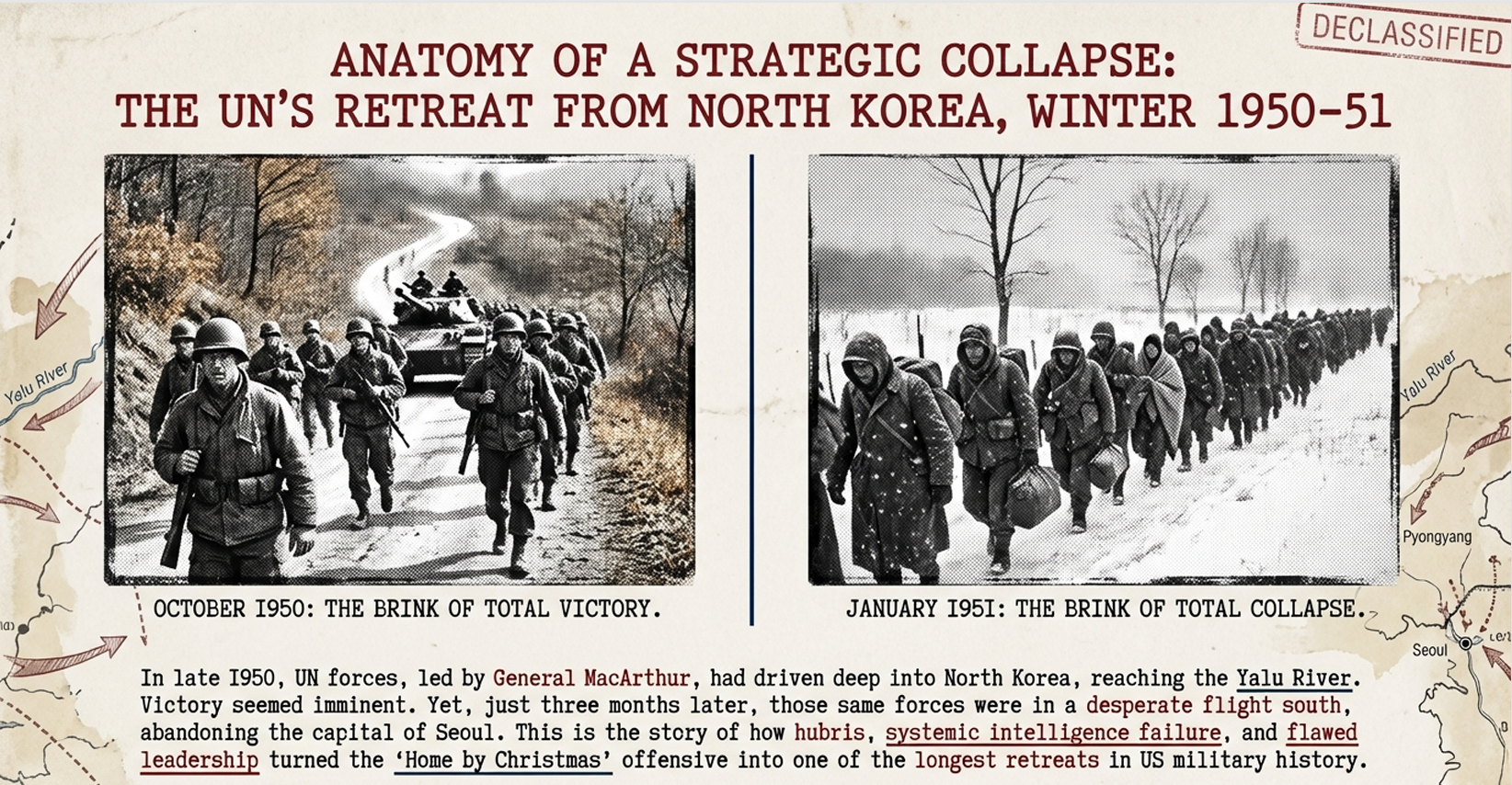
The evacuation of Seoul by Republic of Korea (ROK) and United Nations (UN) forces on January 4, 1951—colloquially known as the "1.4 Retreat"—stands as one of the most dramatic and tragic turning points in the history of the Korean War. Following the spectacular success of the Incheon Landing in September 1950, allied forces had surged northward, reaching the Yalu and Tumen Rivers, only to be forced back to the 37th parallel (Pyeongtaek-Samcheok line) just three months later.1 This report transcends a mere chronological record of the war situation to deeply analyze the military and geopolitical background of why the command leadership had no choice but to make the extreme decision to retreat.
Furthermore, it critically examines how vital intelligence that could have altered the war's trajectory was ignored (information asymmetry) and explores counterfactual history scenarios to understand how different strategic decisions might have reshaped the outcome. Specifically, it will elucidate the catastrophic consequences of the information asymmetry between MacArthur's intelligence staff and field commanders, deriving implications for modern military strategy and intelligence analysis.
Part 1: Historical and Strategic Background of the 1.4 Retreat
1.1 The Advance into the Void: Intoxication with Victory
In October 1950, ROK and UN forces breached the 38th parallel and commenced their drive north. At the time, the UN Command in Tokyo considered the collapse of the North Korean regime a fait accompli. Under the optimistic slogan "Home by Christmas," General of the Army Douglas MacArthur dispersed his forces northward.2 This optimism led to a reckless overextension of the front. A massive gap of approximately 80 kilometers (50 miles), created by the rugged Nangnim Mountains, separated the US Eighth Army on the western front from the US X Corps on the eastern front.3 This gap was a tactical blind spot where mutual support was impossible, eventually serving as the decisive corridor through which Chinese forces infiltrated to defeat UN units in detail.
1.2 Covert Chinese Intervention and the Shock of Maneuver Warfare
Although the main force of the North Korean People's Army (KPA) had been effectively neutralized following the Pusan Perimeter and Incheon campaigns, Mao Zedong had been covertly deploying massive forces across the Yalu River since October.1 The Chinese People's Volunteer Army (PVA) adopted tactics of strict night maneuvering, mountain infiltration, and encirclement to neutralize the UN's superior firepower. They remained concealed in forests during the day and moved only at night to evade UN aerial reconnaissance.4 The First Phase Offensive in late October 1950 served as a warning, yet UN forces underestimated it as sporadic resistance by small numbers of volunteers. The subsequent Second Phase Offensive in late November (Battle of the Ch'ongch'on River, Battle of Chosin Reservoir) saw Chinese forces completely flank and inflict devastating blows on UN troops.2
1.3 Strategic Inevitability of Abandoning Seoul: Trading Space for Time
By late December 1950, with the Chinese Third Phase Offensive (New Year's Offensive) imminent, the front line had already been pushed back to the vicinity of the 38th parallel. Lieutenant General Matthew B. Ridgway, who had recently assumed command of the US Eighth Army, faced a grim reality upon inspecting the front.
1.Collapse of Combat Power: ROK divisions, suffering from a lack of equipment and training, were crumbling under Chinese psychological warfare and encirclement tactics, leaving the defensive line breached in multiple locations.6
2.Threat of Encirclement: The collapse of the western front meant the exposure of the flanks of the main US forces. Attempting to hold Seoul would risk the isolation and annihilation of the main body north of the Han River.
3.Political Symbolism vs. Military Pragmatism: Ridgway aimed to preserve military capabilities to secure a footing for a future counteroffensive, even at the cost of abandoning the political symbol of Seoul. This was a highly calculated strategic decision to "trade space for time and force preservation".1
| Category | Situation in Dec 1950 | Strategic Rationale for 1.4 Retreat |
| Front Status | Unstable defense at 38th Parallel; ROK divisions nearing collapse | Risk of main force encirclement if holding position |
| Enemy Force | Chinese 3rd Offensive engaged; numerical superiority & psychological pressure | Induce extension of Chinese supply lines & wait for culminating point |
| Friendly Force | Low morale, logistical confusion, commander change (Walker $\rightarrow$ Ridgway) | Need time for reorganization & recovery of fighting spirit |
| Key Objective | Defend Seoul (Political) | Preserve UN Force (Military) |
Part 2: The Tragedy of Information Asymmetry and Systemic Ignorance
Behind the tragedy of the 1.4 Retreat lies a systemic intelligence failure where clear warning signs were ignored. This was not a lack of intelligence, but a catastrophe born of "Confirmation Bias" and the politicization of intelligence, where existing data was interpreted or discarded to fit the leadership's narrative.
2.1 K.M. Panikkar’s Warnings: The Ignored Diplomatic Signal
K.M. Panikkar, the Indian Ambassador to Beijing, served as the sole and crucial conduit conveying China's intent to intervene to the Western world through his meetings with Zhou Enlai. At midnight on October 2, 1950, Zhou Enlai summoned Panikkar to explicitly warn that "if US troops cross the 38th parallel, China will intervene".7 Panikkar immediately cabled this to his government and the West, expressing concern that "America has knowingly elected for war".8
However, the response from Washington and Tokyo was cynical.
·Dean Acheson (US Secretary of State): He dismissed Panikkar’s warning as "mere vaporings of a panicky Panikkar".8 Western leaders distrusted his intelligence, suspecting him of being soft on communism.
·President Truman and General MacArthur: At the Wake Island Conference (October 15, 1950), MacArthur confidently assured Truman that there was "little chance" of Chinese intervention and that if they did try, "there would be the greatest slaughter" by US air power.9
2.2 Charles Willoughby’s Intelligence Monopoly and Distortion
Major General Charles Willoughby, MacArthur's Assistant Chief of Staff for Intelligence (G-2), is identified as a key figure in this intelligence failure. He systematically excluded or minimized unfavorable intelligence to support MacArthur's strategic goal of "unification by marching north".11
·Minimization and Suppression: Despite reports from field commanders and the CIA indicating signs of large-scale Chinese troop movements (troop concentrations near the Manchu border, POW interrogation results), Willoughby downgraded these to "a small number of volunteers" or "security forces." In reality, over 260,000 Chinese troops had already crossed the Yalu and were lying in ambush, yet Willoughby reported to MacArthur a fatally incorrect estimate that "Chinese strength is less than 50,000".8
·Blocking Reporting Channels: Willoughby selectively filtered intelligence to align with what MacArthur wanted to hear, blocking analysis from the CIA or other agencies from reaching the General. This blinded the commander and created an "Echo Chamber Effect" that reinforced MacArthur's misjudgments.11
2.3 Suppression of CIA and Field Intelligence
The CIA had detected multiple signs of Chinese intervention starting in mid-October 1950.
·Medical Supplies and Troop Movements: Intelligence indicated China was purchasing large quantities of medical supplies abroad and that over 300,000 troops had massed in Manchuria.10
·POW Interrogations: By late October 1950, US forces had captured regular Chinese soldiers, confirming they were deployed as organized units.12
However, Willoughby and the MacArthur command interpreted these clear evidences as merely "individual volunteers," minimizing their strategic significance. This was less an "intelligence failure" and more a "failure of intelligence management".8
Part 3: Attribution of Responsibility - Strategic Misjudgment and Leadership Failures
While responsibility for the 1.4 Retreat cannot be pinned on a single individual, the definitive errors and lack of leadership among key commanders can be clearly identified.
3.1 General of the Army Douglas MacArthur: Hubris and Strategic Myopia
Intoxicated by the success at Incheon, MacArthur failed to view the battlefield objectively.
·The Error of Force Dispersion: Ignoring the geographical characteristics of northern Korea (the Nangnim Mountains), he committed the strategic error of advancing with his forces split between the West (Eighth Army) and the East (X Corps). The massive gap between the two units provided the Chinese with a perfect infiltration route.3
·Denial of Reality and Deflection: Even after Chinese intervention was confirmed, he insisted on continuing the offensive rather than shifting to a defensive posture, exacerbating allied losses. As the situation deteriorated, he attempted to deflect blame onto Washington's policies, which ultimately contributed to his dismissal.13
3.2 Major General Edward Almond: Tactical Incompetence and Discord
As MacArthur's chief of staff and commander of X Corps, Edward Almond is criticized for tactical incompetence and discord with subordinate commanders.
·Reckless Advance Orders: During the Chosin Reservoir campaign, despite Major General O.P. Smith of the 1st Marine Division advising a cautious advance, Almond ignored the terrain, weather, and enemy situation, demanding an unconditional rapid advance. He dismissed Smith's concerns as "defeatism," insisting "there are no Chinese".14
·Destruction of Task Force Faith: Almond's reckless orders pushed the US Army 7th Division's 31st Regimental Combat Team (Task Force Faith) east of Chosin, where they were encircled and suffered near-total annihilation. This remains a tragic example of how a commander's misjudgment costs soldiers' lives.15
·Failure of Coordination: His friction and rivalry with Lieutenant General Walton Walker of the Eighth Army prevented organic coordination across the entire front. Almond maintained a deformed command structure by reporting directly to MacArthur rather than coordinating with Walker.3
3.3 Major General Charles Willoughby: The False Prophet
As previously mentioned, as the intelligence chief, he prioritized protecting his commander's ego over objective analysis. His manipulation of intelligence fundamentally deprived the command of the opportunity to make correct decisions, and his intelligence failures were subject to intense scrutiny in post-war US Senate hearings.17
Part 4: Counterfactual History - Applying "IF" to History
Although history has no "ifs," simulating outcomes based on military conditions and geography at the time provides critical insights for future strategic planning. The "Waist Line" defense theory is cited by military experts as the most viable alternative.
4.1 Scenario A: Holding the Pyongyang-Wonsan Line (The Waist)
What if UN forces had stopped their advance at the peninsula's narrowest point, the Pyongyang-Wonsan line (roughly near the 39th parallel), and established a strong defensive line?.5
·Hypothesis: In October 1950, after capturing Pyongyang and Wonsan, UN forces halt the northward advance and fortify the shortest distance across the peninsula (approx. 160km).
·Strategic Advantages:
o Increased Troop Density: A shorter front line would have drastically increased the density of available troops, enhancing defensive power. The front length would be approximately 40% shorter than the line near the 38th parallel.
o Shortened and Stabilized Supply Lines: Land supply lines from Busan to Pyongyang would be far more stable than those stretching to the Yalu, and maritime resupply via Wonsan would be easily facilitated.
o Buffer Zone: Avoiding direct contact with the Chinese border would weaken China's justification for intervention or force Chinese troops to traverse disadvantageous mountainous terrain if they did intervene.
·Projected Outcome:
o Restricted Chinese Maneuver: Large-scale Chinese encirclement maneuvers would have been limited by the narrow front and fortified firepower.
o Stabilized Front: A rapid collapse like the 1.4 Retreat would likely not have occurred.
o Geopolitical Shift: The border would likely have formed much further north than the current DMZ, potentially incorporating Pyongyang and Wonsan into South Korean territory. This might have pushed the North Korean regime into the resource-poor northern mountains, potentially leading to its long-term attrition.19
4.2 Scenario B: Heeding Intelligence and Preemptive Action
What if Acheson and MacArthur had taken Panikkar’s warnings seriously and sought a political solution?
·Hypothesis: Upon receiving intelligence of Chinese intervention in early October 1950, the UN stops the advance, builds defensive positions at key points north of the 38th parallel, and attempts diplomatic negotiations.
·Projected Outcome:
o Military Preservation: The element of surprise for the Chinese would be neutralized, and allied forces would be preserved.
o Early Armistice: Aligning with the Truman administration's desire to avoid escalation, early armistice negotiations might have proceeded. While the opportunity for unification would be lost, the prolongation of the war, millions of civilian casualties, and the total devastation of the land could have been prevented.
4.3 Scenario C: Refusing the 1.4 Retreat and Defending Seoul
What if General Ridgway had refused to abandon Seoul and ordered a defense to the death?
· Hypothesis: Despite the threat of encirclement during the Chinese Third Phase Offensive, Seoul is held due to political pressure.
·Projected Outcome:
o A Second Dunkirk or Stalingrad: The US I and IX Corps on the western front would highly likely have been encircled and annihilated by the Chinese.1 Isolated north of the Han River with cut-off retreat routes, UN forces would have surrendered or been wiped out amidst severed supplies and inferior numbers.
o Communization of the Peninsula: The loss of the main force would mean the entire peninsula becomes indefensible, leading directly to defeat. Ridgway's decision to retreat, though humiliating, was the only solution for "strategic survival through tactical retreat."
Part 5: Execution of the 1.4 Retreat and the Scorched Earth Policy
5.1 Ridgway’s Leadership and Cold Realism
While MacArthur was consumed by strategic abstractions in Tokyo, Ridgway was a thorough realist on the ground. He recognized that allied morale was at rock bottom and a "defeatist mindset" was prevalent.
·Tactical Retreat: He clarified that preserving the army took precedence over holding "real estate." He withdrew to the 37th parallel to regroup and wait for Chinese supply lines to reach their limit.6
·Preparation for Offensive Defense: While retreating, he did not merely flee but prepared for a counterattack. He encouraged commanders and shifted tactics to concentrate firepower and inflict attrition on the enemy.
5.2 Scorched Earth Operations and Civilian Suffering
During the retreat, Ridgway ordered a harsh "Scorched Earth Policy" to destroy all facilities and supplies usable by the enemy.
·Infrastructure Destruction: Key infrastructure in Seoul and other cities, including buildings, bridges, railways, and supply depots, was systematically destroyed. Airfields in Incheon and Suwon were torched.22
·Civilian Control and Tragedy: The control of the Han River bridges was a terrible ordeal for refugees. Ridgway restricted entry to the bridges after certain hours to ensure the smooth withdrawal of the military, leaving countless refugees exposed to the cold and enemy attacks. He even ordered massive incendiary bombings on Pyongyang after the withdrawal, burning the entire city.24 While militarily effective in delaying the enemy, it left indelible scars from a humanitarian perspective.
5.3 Chinese Casualties and the Culminating Point
The UN's scorched earth tactics and powerful aerial bombardment inflicted massive casualties on the Chinese as well. Due to extended supply lines, severe cold, and UN air strikes, Chinese troop losses skyrocketed, and they reached their culminating point at the Suwon-Icheon line shortly after the 1.4 Retreat. This provided the UN forces the opportunity to launch a counteroffensive.6
| Category | UN Command | Chinese PVA |
| Strategic Goal | Force preservation, delaying action, prep for counterattack | Annihilate UN forces, expel from peninsula |
| Key Tactics | Mobile defense, firepower concentration, scorched earth | Flanking maneuvers, night attacks, human wave |
| Logistics | Excellent sea/air supply; denial of local resources via scorched earth | Severe food/ammo shortages due to extended lines; high frostbite rate |
| Casualties/Damage | Abandonment of Seoul, equipment loss, massive civilian toll | Massive combat/non-combat (frostbite) losses; loss of offensive capability |
Conclusion: Lessons and Legacy of a Painful Retreat
The 1.4 Retreat was not a simple defeat, but a structural disaster combined of Hubris, Intelligence Failure, and a Crisis of Leadership. MacArthur and Willoughby’s "Confirmation Bias" provided the Chinese with a perfect opportunity for surprise, and Almond’s reckless tactics drove allied forces to the brink of death. However, thanks to General Ridgway’s cool-headed strategic retreat in a desperate crisis, the UN forces avoided annihilation and were later able to reverse the tide in battles like Chipyong-ni, securing the current Armistice Line.
Had the advance stopped at the "Pyongyang-Wonsan Line," or had warnings been heeded and prepared for, the border of a unified Korea might have been much further north. While history cannot be undone, the lessons of the 1.4 Retreat remain valid today: "Do not underestimate the enemy, listen to unwelcome intelligence, and prioritize cool-headed judgment for survival over justification." This is the solemn message that the frozen Korean winter of over 70 years ago sends to us today.
#1.4후퇴 #KoreanWar #IntelligenceFailure #MacArthur #Ridgway #CounterfactualHistory #Strategy #Geopolitics #ColdWarHistory #MilitaryLeadership
참고 자료
1.1.4 후퇴 - 나무위키,1.4 후퇴 - 나무위키
2.Battle of the Ch'ongch'on River - Wikipedia,, Battle of the Ch'ongch'on River - Wikipedia
3.Differing Views of Success by Nations and Echelons at the Chosin Reservoir,Differing Views of Success by Nations and Echelons at the Chosin Reservoir
4.92 - Chinese deception tactics and US self deception on the Yalu River - 1950,92 - Chinese deception tactics and US self deception on the Yalu River - 1950 | The Principles of War Podcast
5.Chinese intervention in the Korean War - LSU Scholarly Repository, Chinese intervention in the Korean War
6.Matthew Ridgway's Eighth Army at Seoul - Warfare History Network, Matthew Ridgway's Eighth Army at Seoul - Warfare History Network
7.The Chinese Intervention in Korea: An Analysis of Warning - DTIC,, https://apps.dtic.mil/sti/tr/pdf/ADA165286.pdf
8.Catastrophe on the Yalu: America's intelligence failure in Korea - Brookings Institution, Catastrophe on the Yalu: America’s intelligence failure in Korea | Brookings
9.Approved for Release: 2014/09/03 C06122508 - CIA, https://www.cia.gov/readingroom/docs/DOC_0006122508.pdf
10. Two Strategic Intelligence Mistakes in Korea, 1950 - CIA, Two Strategic Intelligence Mistakes in Korea, 1950
11. Loyalty First: The Life and Times of Charles A. Willoughby, MacArthur's Chief Intelligence Officer - Air University, Loyalty First: The Life and Times of Charles A. Willoughby, MacArthur's Chief Intelligence Officer
12.Charles A. Willoughby - Wikipedia,Charles A. Willoughby - Wikipedia
13.MacArthur Recall — Far East Policy - CQ Almanac Online Edition, MacArthur Recall — Far East Policy
14. An Analysis of the Press Coverage of Douglas MacArthur during the Battle of Chosin Reservoir - Chapman University Digital Commons, An Analysis of the Press Coverage of Douglas MacArthur during the Battle of Chosin Reservoir
15.Nightmare at the Chosin Reservoir - The Army Historical Foundation, Nightmare at the Chosin Reservoir - The Army Historical Foundation
16.US Forces Critical Vulnerabilities Before and During the Battle of the Chosin Reservoir - DTIC,US Forces Critical Vulnerabilities Before and During the Battle of the Chosin Reservoir
17.Intelligence Failure in Korea: Major General Charles A. Willoughby's Role in the United Nations Command's Defeat in Nove - DTIC,Intelligence Failure in Korea: Major General Charles A. Willoughby's Role in the United Nations Command's Defeat in Nove
18.Chapter 9: Retreat to the South - Naval History and Heritage Command,Chapter 9: Retreat to the South
19.What If UN Forces Stopped at the Narrowest Part of the Korean Peninsula - Reddit,What If UN Forces Stopped at the Narrowest Part of the Korean Peninsula : r/AlternateHistory
20.UN Forces retreat from North Korea - Wikipedia,UN Forces retreat from North Korea - Wikipedia
21.HEADQUARTERS EIGHTH UNITED STATES ARMY KOREA (EUSAK) Office of the Commanding General 21 January 1951 MEMORANDUM FOR,HEADQUARTERS EIGHTH UNITED STATES ARMY KOREA (EUSAK) Office of the Commanding General 21 January 1951 MEMORANDUM FOR
22.BATTLE OF KOREA: Scorched-Earth Retreat - Time Magazine, BATTLE OF KOREA: Scorched-Earth Retreat | TIME
23.U.S. Army Corps of Engineers Headquarters > About > History > Historical Vignettes > Military Construction Combat > 098 - Korean War,U.S. Army Corps of Engineers Headquarters > About > History > Historical Vignettes > Military Construction Combat > 098 - Korean War
24.Scorch Marks - The Wilson Quarterly, Scorch Marks | Wilson Quarterly
25.The Destruction and Reconstruction of North Korea, 1950 - 1960 北朝鮮の破壊と再建, The Destruction and Reconstruction of North Korea, 1950 - 1960 北朝鮮の破壊と再建
26.Korean War order of battle: Chinese - Wikipedia, Korean War order of battle: Chinese - Wikipedia
#1.4후퇴 #KoreanWar #IntelligenceFailure #MacArthur #Ridgway #CounterfactualHistory #Strategy #Geopolitics #ColdWarHistory #MilitaryLeadership
'우리들의 AI 윤리 이야기 > 기억의 윤리' 카테고리의 다른 글
| "기계의 오판 vs 인간의 직감! 핵전쟁을 막은 페트로프 중령이 AI시대에 던지는 경고" (1) | 2026.04.23 |
|---|---|
| 제주 4.3항쟁의 역사적 복원과 AI 시대의 윤리적 기억: 침묵의 심연에서 세계적 인권의 상징으로 (0) | 2026.04.03 |
| 1950년 12월 흥남철수작전 기록: 메러디스 빅토리호의 항해 (0) | 2025.12.15 |
| 11월 11일 11시, 당신의 1분은 어디를 향하고 있습니까? (1) | 2025.11.08 |
| AI 시대 제597돌 한글날 : 위대한 유산, 한글의 어제와 오늘, 그리고 내일 597th Hangeul Day (0) | 2025.10.09 |


